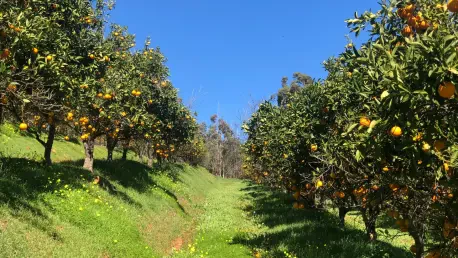

The heavy scent of ripening nectarines usually signals a season of profit for a Central Valley grower, but for Cesar Mora, it became the aromatic marker of a mounting legal catastrophe. In the sun-drenched orchards of Reedley, California, a third-generation farmer found himself in a position that defies common sense: surrounded by a bumper crop of premium white nectarines that he was legally forbidden from selling. Rather than letting the fruit rot, Mora opened his gates to the public, giving away over 100,000 pounds of his harvest to a community that arrived in droves with buckets and bags. This was not a planned act of philanthropy but a desperate response to a legal injunction from a major food distributor that effectively froze his livelihood.
The sight of thousands of residents harvesting free fruit highlights a deepening rift in American agriculture, where the person who tills the soil may no longer own the harvest it yields. This scenario, while heartwarming for the recipients, underscores a reality for small-scale producers. If a legal document can prevent a farmer from selling the food they nurtured, the fundamental concept of land ownership begins to shift toward a system of corporate oversight. This dispute serves as the nut graph of a much larger story regarding the corporate takeover of genetic material in the modern food supply.
100,000 Pounds of Forbidden Fruit: The Charity Born of a Legal Lockout
Cesar Mora’s “Monalise” nectarines were meant for high-end grocery shelves, not for a mass giveaway in the dirt of his own driveway. However, a legal battle with Giumarra Brothers Fruit Co. led to a court-ordered injunction that prohibited him from selling or even moving the fruit to a commercial packer. The community response was immediate and overwhelming, as families from across the region sought to salvage what the legal system had deemed unmarketable. This act of civil generosity provided a temporary solution to the waste, yet it did nothing to recoup the massive financial losses incurred by the farm.
The conflict represents a definitive case study in the friction caused by agricultural sublicensing. While the public saw a man giving back to his neighbors, the legal system saw a breach of contract that took precedence over the preservation of food. This tension illustrates how corporate marketing agreements have become the dominant force in the orchard, often leaving the grower with the bill for production but none of the authority over the distribution. For the residents of Reedley, the free nectarines were a gift; for the Mora family, they were a somber reminder of a lost season and a compromised future.
The Evolving Landscape of Seed Ownership and Corporate Agricultural Control
To understand how a farmer can lose the right to sell his own crop, one must look at the seismic shift in how new fruit varieties are managed. Traditionally, agricultural mainstays like the Rainier cherry or the Honeycrisp apple were developed by public universities and eventually entered the public domain, allowing any grower to plant and profit from them. However, the industry has pivoted toward a “club” model, a system where private companies or research institutions patent specific genetic profiles. Under this framework, a fruit variety is treated like proprietary software; the farmer licenses the right to grow it, often under strict conditions that dictate where, how, and through whom the final product must be sold.
This shift has transformed the agricultural heartland into a complex web of intellectual property rights, where corporate control often supersedes the traditional autonomy of the independent grower. When a farmer enters a club variety agreement, they are essentially becoming a tenant of a genetic landlord. The distributor holds the keys to the market, and the grower provides the land and labor. This imbalance of power has become the new standard in specialty crops, making it increasingly difficult for independent operators to maintain a diversified and independent business model without bowing to the demands of large-scale marketing firms.
Anatomy of the Monalise Dispute: Royalties, Exclusivity, and Broken Partnerships
The conflict between Mora and Giumarra highlights three critical points of failure in modern agricultural contracts. First, the cost of entry is prohibitively high, involving multiple layers of fees such as a $2.50 royalty per tree and a 4% production royalty on all gross sales. These costs are extracted before the farmer sees any profit, placing the entirety of the financial risk on the producer. Second, the exclusivity trap mandates that every piece of fruit grown be packed and sold through a single distributor, removing the farmer’s ability to seek better market prices elsewhere or respond to local demand.
Operational friction further complicates these partnerships, as seen when allegations of product waste and unauthorized international sales in Taiwan soured the professional relationship between the two parties. When Mora attempted to bypass his distributor to save his crop from being discarded, the act triggered the lawsuit and the subsequent injunction. This breakdown in trust demonstrates that once a farmer is locked into an exclusive marketing agreement, they have very few exit ramps if the distributor fails to perform their duties. The resulting legal deadlock can be more damaging than a drought or a pest infestation, as it strikes at the legal right to participate in the economy.
Judicial Precedent and the Power of Private Law in the Orchard
The legal proceedings in the Fresno County Superior Court revealed a startling reality: a formal patent is not always necessary for a distributor to exert total control over a crop. While Mora’s legal team argued that the distributor misrepresented the Monalise as a patented variety, the court ruled that the absence of a federal plant patent did not invalidate the signed contract. This reinforces the concept of “private law,” where the specific terms of a sublicensing agreement carry more weight than the broader status of the fruit’s genetics.
Expert insights from agricultural economists suggest that this trend is only accelerating, as the industry moves further away from open-source farming. The ruling indicates that if a grower signs a contract agreeing to exclusivity, they are bound by those terms regardless of whether the variety is truly unique or publicly available. This judicial stance creates a environment where the contract becomes the ultimate authority, often leaving farmers with little recourse when the business relationship turns adversarial. It signals a future where legal literacy is just as important as soil health for the survival of the American farm.
Protecting the Harvest: A Framework for Navigating Agricultural Sublicensing Agreements
For independent growers, the Mora case served as a cautionary tale that necessitated a more rigorous approach to signing production and marketing contracts. To maintain operational agency, farmers adopted several key strategies. They began to independently verify the patent status of any “exclusive” variety through the U.S. Patent and Trademark Office before committing to high-royalty structures. Furthermore, they negotiated performance clauses that allowed them to void exclusivity if a distributor failed to move a specific percentage of the crop or if product waste exceeded a specific threshold. These protective measures ensured that the farmer was no longer a silent partner in the marketing of their own labor.
Independent growers also recognized the importance of diversifying their crop portfolios to ensure that a single legal dispute could not jeopardize an entire annual income. They balanced proprietary club varieties with robust public-domain crops, creating a financial buffer against the risks of corporate litigation. In the years following the dispute, the industry saw the rise of grower-led cooperatives that provided collective bargaining power against large distributors. These initiatives eventually restored a sense of balance to the agricultural heartland, empowering the people who tilled the soil to reclaim the rights to the harvest. By prioritizing legal transparency and operational flexibility, the farming community successfully navigated the complexities of intellectual property to protect the legacy of their land.