
A Market in Suspended Animation: The Quiet Before the Data Storm
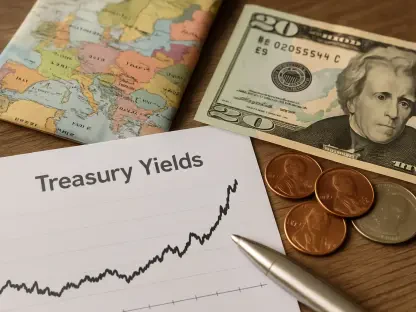
In the world of finance, stillness can be more telling than volatility, a scene currently playing out in the U.S. Treasury market, where benchmark yields are holding remarkably steady, seemingly unfazed by conflicting economic signals. The benchmark 10-year Treasury yield, a critical barometer for everything from mortgage rates to global investor sentiment, has settled into a tight range around 4.155%, mirroring the placid behavior of its 2-year and 30-year counterparts. This market-wide pause is not a sign of complacency but rather one of intense anticipation. This article will explore the delicate balance holding Treasury yields in check, examining why investors have absorbed the latest labor market news and are now fixated on one impending data point: the November inflation report.
The Road to a Standstill: Unpacking the Fed’s Recent Pivot
To understand today’s market indecision, one must look back at the Federal Reserve’s recent policy shift. Not long ago, the central bank was on a clear path of monetary tightening. However, faced with mounting economic risks, the Fed executed a significant pivot, implementing three consecutive interest rate cuts. This decisive action was designed to insulate the economy and sustain the expansion. The bond market, which is perpetually forward-looking, swiftly priced in this more accommodative stance. As a result, the impact of those cuts has been largely absorbed, leaving investors to grapple with a new reality: the Fed is now “on hold,” signaling that the bar for future rate adjustments is considerably higher.
Decoding the Market’s Current Stance
The Mixed Messages of a Cooling Labor Market
The primary source of the market’s current tension is the U.S. labor market, which is sending contradictory signals. A recent jobs report painted a picture of underlying weakness, with October payrolls showing a decline of 105,000 and the unemployment rate rising to 4.6%. While a subsequent report for November showed a better-than-expected addition of 64,000 jobs, the broader consensus is that the job market’s momentum is fading. This narrative typically puts downward pressure on Treasury yields, but the market’s muted reaction suggests investors see this weakness as confirming the Fed’s recent policy pivot, but not enough to force another immediate cut.
Pricing in the Pause: The Fed’s New Neutral Stance
With the labor market’s slowdown reinforcing the Fed’s decision to pause, investor attention has turned to predicting the central bank’s next move. The futures market provides a clear window into these expectations. Currently, fed funds futures indicate only a 24% probability of another rate cut in January, a sign that the market has fully embraced the “on hold” narrative. This sentiment has created a floor for Treasury yields. While economic weakness might argue for lower yields, the Fed’s stated intention to wait and assess incoming data prevents them from falling much further.
Inflation as the Tie-Breaker
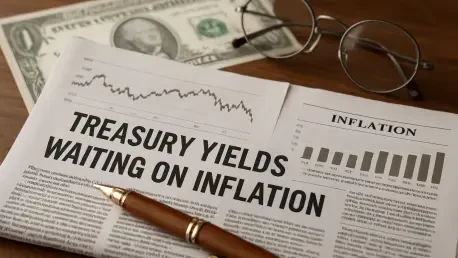
With the jobs data digested and the Fed’s pause accepted, the bond market is in a holding pattern. The next significant move now hinges almost entirely on the forthcoming Consumer Price Index (CPI) report. Inflation is the critical missing piece of the puzzle. A lower-than-expected inflation reading would validate the Fed’s recent cuts and likely send Treasury yields lower. Conversely, a surprisingly high inflation number would complicate the Fed’s position immensely, handcuffing it from cutting rates despite a weak labor market and potentially pushing yields higher.
Future Outlook: Navigating the Data-Dependent Path Forward
Looking ahead, the market’s trajectory will be defined by its hypersensitivity to key economic reports, particularly on inflation and employment. The current stability in Treasury yields is fragile and could be shattered by any data that meaningfully alters the outlook for Federal Reserve policy. A significant deviation from expectations in the CPI report will almost certainly trigger a repricing across the bond market, leading to a sharp move in yields. This dynamic suggests an era where macroeconomic data points will have an outsized impact on day-to-day market activity.
Strategic Takeaways for Navigating an Expectant Market
The key takeaway from the current environment is that the Treasury market is balanced on a knife’s edge. The downward pressure from a weak labor market is being perfectly counteracted by a Federal Reserve that has signaled a firm intention to remain on the sidelines. For investors, this translates into a clear strategic imperative: exercise caution. The current low volatility is a temporary condition, not a new normal. Making aggressive bets on the direction of interest rates before the release of key inflation data is a high-risk endeavor.
Conclusion: The Decisive Moment Awaits
The U.S. Treasury market was revealed to be a study in quiet anticipation. Yields held stable not out of certainty, but because of a perfect equilibrium of competing forces: a softening economy on one side and a resolute central bank on the other. This holding pattern underscored the critical role that inflation now plays in the economic narrative. It was identified as the single variable that could tip the scales, forcing the Federal Reserve’s hand and setting the course for interest rates. The impending CPI report, therefore, was shown to be more than just another statistic; it was the event that would resolve the market’s indecision.