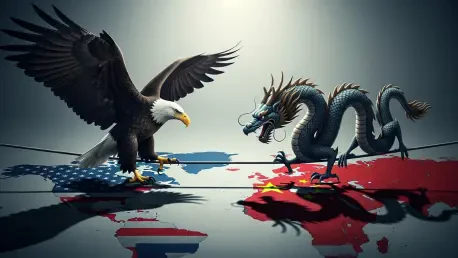

The high-stakes diplomatic theater unfolding in Beijing this week serves as a definitive litmus test for the future of global stability and economic integration between the world’s two largest powers. As President Donald Trump returns to the Chinese capital for the first time since 2017, the geopolitical landscape has shifted from one of cautious engagement to a period of intense structural competition and technological decoupling. This summit is not merely a ceremonial exchange but a critical working engagement necessitated by the rapid acceleration of artificial intelligence, shifting semiconductor supply chains, and rising tensions in the Taiwan Strait. With the global economy hanging in the balance, the discussions held within the Great Hall of the People are designed to establish a new framework for coexistence that prevents total systemic fracture. The presence of high-level industrial titans alongside traditional diplomats indicates that the definition of national security has expanded to include the very digital foundations of the modern world.
Diplomatic Protocol and the Spectacle of the State Visit
The meticulously choreographed arrival of the American delegation at Beijing Capital International Airport on May 13 provided a visual testament to the gravity of the current bilateral situation. President Trump was greeted on the tarmac by Vice President Han Zheng and a meticulously organized reception committee of nearly three hundred flag-waving youths, a gesture by the Chinese state intended to signal a high level of hospitality despite the underlying friction. This carefully staged welcome followed days of intense logistical coordination, which saw the arrival of multiple U.S. Air Force C-17 Globemaster III aircraft to deliver the presidential motorcade and secure communication equipment. The scale of these preparations highlighted the immense complexity of managing a state visit in an era where security concerns and political optics are inextricably linked, setting a tone of professional decorum that mask the deep-seated rivalries currently defining the trans-Pacific relationship.
The formal welcoming ceremony at the Great Hall of the People further emphasized the historical weight of this meeting through powerful symbolic displays and traditional statecraft. As the armored presidential limousine, known as “The Beast,” navigated the expansive courtyard of the historic venue, the sight of the People’s Liberation Army honor guard standing alongside the American flag served as a poignant reminder of the high stakes involved. These ceremonial proceedings were more than just pageantry; they functioned as a necessary diplomatic buffer, allowing both leaders to project an image of mutual respect and institutional stability before transitioning into the adversarial realities of the negotiating table. By maintaining these traditional protocols, Beijing and Washington are attempting to preserve a veneer of normalcy that prevents the competitive nature of their relationship from descending into a more volatile and unpredictable form of open hostility on the world stage.
A Fusion of Political Power and Private Sector Influence
A defining characteristic of this specific diplomatic mission is the unprecedented integration of federal executive power with the primary drivers of American technological and industrial innovation. President Trump is accompanied by a cohort of cabinet officials who represent a hawkish stance on national interests, including Secretary of State Marco Rubio and Secretary of Defense Pete Hegseth, both of whom have been vocal about the need for a robust American posture in the Indo-Pacific. However, the inclusion of Treasury Secretary Scott Bessent and Senior Advisor Stephen Miller suggests a dual focus on rigorous economic restructuring and strategic political alignment. This administrative lineup is designed to communicate a unified front that prioritizes American sovereignty while acknowledging the necessity of high-level communication channels to manage regional security flashpoints that could otherwise trigger a global economic collapse.
The presence of tech luminaries such as Elon Musk, Jensen Huang, and Tim Cook within the official delegation signals a fundamental shift in how the United States conceptualizes its diplomatic leverage. By bringing the chief executives of Tesla, Nvidia, and Apple to Beijing, the administration is effectively asserting that technological sovereignty and the integrity of the AI supply chain are now the primary battlegrounds of international relations. These industry leaders serve as both observers and unofficial negotiators, reflecting the reality that corporate supply chains and software ecosystems are as vital to national security as traditional military alliances. Their participation highlights the deep-seated interdependence of the two economies, where American design and Chinese manufacturing remain awkwardly but inextricably linked, even as both nations scramble to achieve greater self-sufficiency in the critical fields of semiconductors and advanced robotics.
Strategic Objectives and the Reality of Deep-Seated Distrust
The agenda for these bilateral discussions is heavily weighted toward the most volatile friction points of the modern era, specifically the governance of artificial intelligence and the stability of global trade routes. Preparatory dialogues held in Seoul between Treasury Secretary Bessent and Chinese Vice Premier He Lifeng laid the groundwork by addressing trade imbalances and market access, yet these talks also underscored the profound lack of trust that continues to hinder long-term agreements. Washington remains focused on protecting intellectual property and reducing the trade deficit, while Beijing seeks to mitigate the impact of American export controls on advanced computing hardware. These competing priorities create a narrow path for negotiation, where any progress on economic cooperation is constantly shadowed by the existential race for technological dominance that defines the current decade.
Beyond the economic sphere, the summit must navigate the treacherous waters of regional and global security, with a specific focus on the Taiwan Strait and the diplomatic posture of Iran. The leaders are tasked with the delicate challenge of maintaining a status quo that has become increasingly fragile as both militaries expand their presence in the South China Sea. While the goal of the summit is often described as “de-risking” the relationship, the reality is that both nations are actively preparing for a future defined by systemic competition rather than partnership. Observers maintain low expectations for any sweeping treaties or breakthrough declarations, viewing the success of the visit through the lens of conflict prevention rather than true reconciliation. The primary objective is to establish functional guardrails that allow for intense competition without the catastrophic consequences of a direct military or economic confrontation.
Future Frameworks for Managed Competition
Moving forward, the international community must recognize that the era of traditional globalization has been replaced by a period of managed friction where technological superiority is the ultimate currency. The outcome of these discussions suggests that future interactions between the United States and China will be increasingly dominated by the private sector’s ability to navigate conflicting regulatory environments and security mandates. Stakeholders should prepare for a landscape where trade is no longer a tool for liberalizing political systems but a primary mechanism for asserting national power. Organizations operating in both jurisdictions must adopt more sophisticated risk-mitigation strategies, focusing on the diversification of supply chains and the development of “localized” technological stacks that can withstand the sudden imposition of new export controls or financial sanctions.
The long-term success of this summit depends on the establishment of a permanent, high-level crisis communication mechanism that includes not just military leaders but also the architects of the global digital infrastructure. This means that future diplomatic efforts must involve a broader range of participants, including AI safety experts and semiconductor logistics specialists, to address the technical complexities of modern rivalry. Rather than seeking a return to the integrated markets of the past, the two powers are likely to settle into a “cold peace” defined by partitioned digital ecosystems and competitive regional influence. For the global market, the next logical step is the creation of more resilient, multi-polar trade networks that do not rely on a single bilateral relationship for stability. This transition will require a significant shift in corporate strategy, favoring agility and regional autonomy over the centralized models that dominated the previous decades.