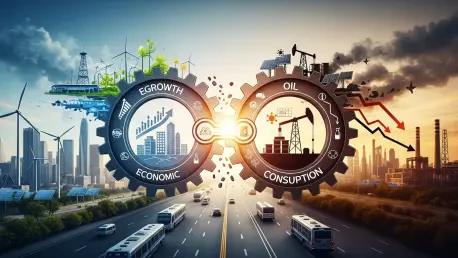

Economic expansion no longer moves in lockstep with petroleum demand as global markets successfully break a century-old correlation between gross domestic product and crude oil consumption. This fundamental shift marks a departure from the industrial era’s reliance on fossil fuels as the primary engine for prosperity. Across major economies, the intensity of oil use per unit of economic output has plummeted, driven by rapid technological advancements and a collective pivot toward alternative energy sources. While historical cycles often saw high oil prices lead to recessions, current market dynamics suggest that nations can now sustain robust growth even amidst energy volatility. This decoupling is not merely a temporary reaction to supply chain disruptions but a structural transformation of the global financial architecture. As service-oriented sectors and digital infrastructure take precedence over heavy manufacturing, the energetic footprint of progress is being rewritten to favor efficiency and carbon neutrality over raw resource extraction.
Drivers of Structural Economic Change
Part 1: Industrial Efficiency and Digitalization
Advanced manufacturing plants have integrated artificial intelligence and real-time data analytics to optimize energy usage, significantly reducing the amount of thermal energy required for production cycles. These smart factories utilize predictive maintenance to prevent energy leaks and employ high-efficiency motors that draw considerably less power than their predecessors from just a few years ago. By shifting toward additive manufacturing and localized 3D printing, companies have also curtailed the need for long-distance logistics, which historically consumed vast quantities of diesel. This optimization ensures that as production volumes rise from 2026 to 2028, the associated carbon and oil footprints remain relatively flat or even decline. The focus has moved from scaling up raw material throughput to maximizing the value extracted from every kilowatt-hour. Consequently, the industrial sector has become a leader in proving that high-value output does not necessitate an equivalent increase in liquid fuel dependency.
Part 2: Transportation and Infrastructure Evolution
The passenger vehicle market has reached a definitive tipping point where electric drivetrains are no longer a niche alternative but the standard for urban and suburban mobility. Massive investments in charging infrastructure between 2026 and 2029 have alleviated range anxiety, making battery-electric vehicles the logical choice for both consumers and commercial fleets. Municipalities have also redesigned transit systems to favor electric light rail and autonomous shuttles, which further reduces the per-capita oil consumption in densely populated regions. This electrification of transport directly removes a major component of oil demand that was previously considered inelastic and essential for economic movement. With solid-state battery technology entering the mass-market phase, the efficiency gains in energy density are allowing for even longer hauls and heavier loads without a drop of gasoline. The ripple effects of this change are visible in the declining demand at the pump, even as the number of miles traveled continues to rise.
Fiscal Resilience and Market Stability
Part 3: Investment Strategies in a Post-Oil Era
Institutional investors have recalibrated their portfolios to prioritize environmental, social, and governance criteria, leading to a massive reallocation of capital away from traditional upstream oil projects. This shift has forced energy companies to reinvent themselves as integrated power providers, focusing on solar, wind, and geothermal assets rather than exploratory drilling. From 2026 to 2030, the financial sector is expected to funnel trillions of dollars into sustainable energy projects that offer more stable, long-term returns compared to the boom-and-bust cycles of the petroleum industry. This divestment from fossil fuels has not triggered the economic collapse that some analysts once feared; instead, it has fostered a more diverse and resilient investment landscape. Venture capital is now flowing into carbon capture technologies and long-duration energy storage, which provide the foundational stability needed for a modern economy. As the financial incentives for oil extraction diminish, the global market is discovering that prosperity is more sustainable.
Part 4: Strategic Planning and Resource Circularity
Stakeholders recognized that the era of unfettered petroleum reliance was drawing to a close and acted decisively to implement structural reforms that favored efficiency. Governments established stringent fuel economy standards and provided the necessary subsidies to accelerate the adoption of renewable energy technologies across all sectors. This proactive approach allowed the global economy to navigate the transition without the catastrophic disruptions that characterized earlier energy shifts. Policy frameworks focused on reskilling the workforce for the green economy, ensuring that the labor market remained dynamic and inclusive as old industries faded. The integration of decentralized energy systems provided local communities with greater autonomy and reduced the systemic risk associated with centralized power grids. These measures collectively ensured that economic growth was no longer a slave to the availability of fossil fuels. By prioritizing long-term sustainability over short-term gains, the international community laid the groundwork for a more stable future.