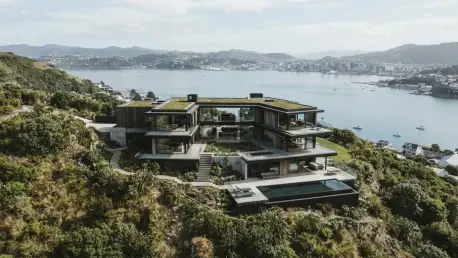

The Wellington residential property market currently navigates a complex period of recovery, marked by a startling and significant divergence between its general housing stock and the prestigious high-end sector. While the average homeowner has faced the sharpest decline in New Zealand’s recent history, the “trophy home” segment is operating with a renewed sense of vigor that contradicts broader economic indicators. This divergence is not merely a statistical anomaly but a reflection of how high-net-worth individuals perceive the capital’s most elite real estate as a hedge against inflation and local market volatility. As the city moves past a period of stagnation, the focus has shifted toward premium estates that offer privacy, architectural significance, and unparalleled views of the harbor. These properties are currently positioned to challenge historical price ceilings, effectively decoupling from the 32 percent downturn that has impacted the middle and lower tiers of the market during this cycle.
Analyzing the Macroeconomic Shifts in the Capital
Understanding the Broad Market Decline
The wider Wellington housing market recently endured a severe correction, driven by a combination of high interest rates and a unique contraction in the public sector. As the seat of the government, the city’s property values are exceptionally sensitive to state employment levels, and the recent loss of thousands of roles significantly dampened consumer confidence. This economic headwind reduced the pool of active buyers in the middle and lower market tiers, leading to a 14 percent drop in overall sales volumes year-over-year. Historically, the city sees approximately 4,000 transactions annually, but recent data shows a dip to just 2,800. This stagnation has left many potential sellers waiting for a more favorable environment, while buyers remain cautious due to cost-of-living pressures and the reduced availability of traditional mortgage financing. The resulting market environment is one of careful observation rather than rapid movement.
Factors Stabilizing the Luxury Property Tier
In contrast to the broader market fatigue, the luxury sector maintains its value through the fundamental principle of scarcity and the financial profile of its participants. High-end buyers are typically insulated from the interest rate fluctuations that plague first-time home buyers, as they often rely on private capital or alternative financing structures. Their motivations are centered on lifestyle acquisitions, privacy, and architectural features that are impossible to replicate, rather than short-term capital gains or mortgage accessibility. This “dream property” focus allows the luxury segment to operate independently of the broader 32 percent market downturn. Even when transaction volumes are low, the resilience of these properties remains high because owners are rarely forced to sell under duress. Consequently, the top tier acts as a separate ecosystem where quality and prestige dictate the price floor, providing a stabilizing effect during periods of wider economic instability.
Landmark Listings Aiming for Historic Benchmarks
Challenging the Six Million Dollar Ceiling
Historically, Wellington’s residential market has rarely exceeded the $6 million threshold, with only four properties in the city’s history ever crossing this significant price benchmark. Most high-end sales tend to cluster between $3 million and $4 million, but several new listings are now aiming to shatter these conventions. For instance, the “Winola” mansion on Jubilee Road in Khandallah is seeking inquiries over $5.75 million, representing a contemporary showpiece that features a tennis court and an outdoor pool. Similarly, the “Middle Harbor” estate on Onslow Road has a tax-assessed value near $5 million, though market rumors suggest expectations are significantly higher, with search filters reaching above the $9 million mark. These listings indicate a bold attempt by sellers to establish a new tier of luxury value in the capital, betting on the fact that truly exceptional assets will find buyers regardless of the wider economic climate or recent market trends.
Unique Architectural Gems Driving Interest
The current inventory of high-end listings features residences with significant historical and architectural pedigree, which continues to drive intense interest from discerning purchasers. Properties like the dramatic redesign of a late-1960s home in Karaka Bay, originally envisioned by the legendary Sir Ian Athfield, offer a level of character that cannot be found in modern subdivisions. Another notable example is the modern, castle-like residence atop Mt. Victoria, which provides panoramic views of the downtown district and harbor with an asking price exceeding $5.495 million. For these buyers, the opportunity to own a piece of Wellington’s architectural history or a uniquely engineered hillside marvel outweighs the general volatility of the housing market. These homes are viewed as functional art pieces, where the intrinsic value is tied to the design rather than local median price fluctuations, thus fueling the ongoing pursuit of record-breaking residential sales.
Buyer Sentiment and Global Investment Trends
Overcoming Market Hesitation and Political Inertia
A documented period of hesitation recently affected buyer commitment in Wellington, largely attributed to a wait-and-see approach during the general election cycle. Historically, wealthy investors in New Zealand pause significant transactions until the political landscape clarifies, seeking certainty regarding tax policies and property regulations. Now that the political direction is established, real estate professionals expect a surge in post-election confidence to unlock several stalled high-value deals. While first-time home buyers have accounted for roughly 40 percent of recent market activity, the “upgrader” segment is only now beginning to emerge from the sidelines. These individuals are looking for definitive signs of market stabilization and potential capital gains before committing to their next move. This shift in sentiment is crucial for the luxury market, as it creates the momentum for the high-end sector to fully transition from cautious observation to active acquisition.
Attracting International Capital to Wellington
The Wellington luxury market is increasingly being bolstered by international interest, particularly from professionals in the film, healthcare, and technology industries. Although high-end sales often require approval from the Overseas Investment Office, these global purchasers provide a vital injection of capital into the local economy. Compared to the more crowded and significantly more expensive markets of Auckland or Queenstown, Wellington’s trophy homes appear strategically undervalued to international eyes. The city offers a unique combination of coastal lifestyle and urban accessibility that is difficult to find in other global hubs. Properties such as waterfront residences in Oriental Bay have specifically attracted this demographic, who prioritize long-term lifestyle assets over the short-term fluctuations of the New Zealand dollar. This global interest helps to set new price benchmarks and ensures that the capital’s most prestigious neighborhoods remain competitive on an international scale.
Strategic Outlook for the Luxury Sector
Predicting Market Recovery into 2027
Industry leaders express a sense of cautious optimism regarding the future of Wellington’s luxury real estate, forecasting a normalization of sales volumes as the market heads toward 2027. While a rapid price boom is unlikely in the immediate term, the market is entering a methodical recovery phase defined by stability and price discovery. Transaction numbers are expected to return to historical norms as the current hesitation fades and buyers recognize the value currently available in the capital. This period will be characterized by a slow but steady increase in activity, where the most unique and architecturally significant properties continue to set the pace for the rest of the city. Experts suggest that the current environment offers some of the best value for money seen in decades, making it a compelling entry point for those with the capital to ignore short-term volatility. The market is several years away from another peak, but the groundwork for the cycle is being laid now.
Why the Luxury Market Ignores Trends
Understanding why the luxury market ignores broader trends requires a focus on the specific dynamics of high-net-worth investment. First, the impact of interest rates is minimized because these buyers often utilize private capital or structured financing that is less sensitive to standard bank rate hikes. Second, a “trophy home” in Wellington is defined by exceptional views, architectural significance, and rare features like historic provenance, making them non-fungible assets that do not follow standard price curves. Finally, international buyers bring top-down capital that helps establish new price benchmarks in prestigious hillside suburbs, regardless of local economic headwinds. These factors combine to create a market where demand is driven by the desire for exclusivity and long-term asset preservation. Because the supply of such properties is naturally limited, the competition for the best estates remains consistent, ensuring that prices remain resilient even when the wider market suffers.
Strategic Recommendations for Future Stability
The unique trajectory of the capital’s elite real estate sector suggests that strategic investors prioritize long-term architectural value over immediate market sentiment. Analysts recommended that those looking to enter the high-end market focus on properties with irreplaceable features, as these assets historically provided the strongest protection against economic downturns. This approach encouraged a shift toward viewing residential property as a diversified asset class rather than just a primary residence. Furthermore, the stabilization of the political environment allowed for a more predictable investment climate, which eventually supported the transition toward a more balanced market dynamic. As the city looked toward the coming years, the emphasis remained on the quality of the built environment and the prestige of established suburbs. These considerations ensured that Wellington remained a competitive destination for capital, setting the stage for a sustainable recovery in the luxury tier.