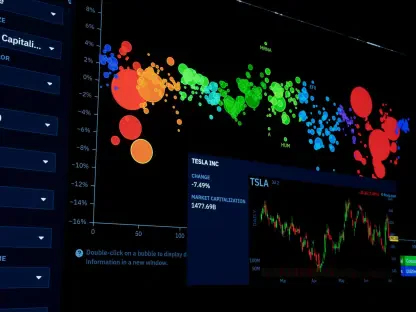

The global financial ecosystem is currently navigating a period of intense turbulence as major economies implement restrictive trade policies that have effectively dismantled years of collaborative industrial growth. This shift toward protectionism has triggered a widespread sell-off across international indices, with investors retreating from high-growth tech sectors that were previously the bedrock of market stability. The primary concern involves the breakdown of established semiconductor supply chains, which are essential for the ongoing expansion of artificial intelligence and cloud computing infrastructure. As diplomatic tensions translate into concrete export bans and heavy import duties, the cost of manufacturing sophisticated hardware has surged, leading to immediate revisions in corporate earnings forecasts. This volatility is not confined to a single region but has created a global contagion effect, where uncertainty in one market rapidly undermines confidence in others. Traders are now bracing for a long period of high volatility.
The Economic Impact: Supply Chains and Innovation
The sudden disruption in the flow of critical raw materials has forced leading technology firms to reconsider their long-term operational viability in a fragmented global landscape. Companies specializing in renewable energy storage and advanced robotics are facing unprecedented delays as the procurement of rare earth metals becomes a tool for geopolitical leverage rather than a standard market transaction. This scarcity has led to a dramatic increase in operational expenses, as firms are now required to invest heavily in alternative sourcing and localized production facilities to maintain their output levels. Moreover, the uncertainty surrounding future trade agreements has caused a significant freeze in venture capital flows toward emerging startups that depend on international scaling. As larger corporations hoard liquidity to cushion against potential supply shocks, the broader innovation ecosystem is experiencing a contraction in research and development spending. This defensive posture is reflected in the declining valuations of growth-oriented stocks.
Beyond the immediate impact on hardware production, the global market is reacting to the rising costs of consumer goods, which threaten to dampen discretionary spending and slow overall economic growth. Retailers and automotive manufacturers are grappling with a new reality where cross-border tariffs add significant premiums to finished products, forcing them to choose between absorbing the costs or passing them on to an already strained consumer base. This inflationary pressure is complicated by the fact that many companies are in the middle of expensive transitions to sustainable technologies, leaving them with little financial flexibility to navigate trade-related price hikes. Market analysts have observed a growing trend of friend-shoring, where businesses attempt to stabilize their operations by partnering exclusively with politically aligned nations. While this strategy offers some protection, it also limits the efficiency of global markets and creates a tiered economic system where growth is hindered by political boundaries.
Looking back at the recent period of economic realignment, successful organizations emphasized the development of resilient logistics networks that prioritized security over short-term cost savings. These entities conducted comprehensive audits of their supply chains to identify vulnerabilities and invested in modular manufacturing systems that allowed for rapid adjustments to changing trade regulations. Financial experts recommended that firms diversify their asset allocations by looking toward emerging regional hubs that offered more predictable regulatory environments and untapped growth potential. Furthermore, the strategic shift toward sovereign technological capabilities ensured that critical industries could function independently during times of heightened international friction. By adopting these proactive measures, businesses were able to mitigate the worst effects of the market downturn and establish a more stable foundation for long-term operations. This transition ultimately required a move away from the hyper-globalized models of the past.