
Priya Jaiswal is a recognized authority in Banking, Business, and Finance, known for her sharp market analysis and deep understanding of how international trends shape portfolio management. Her insights are particularly valuable today as we witness a significant shift in the global energy landscape and a corresponding rally on Wall Street. In this conversation, we explore the cooling of Mideast tensions, the subsequent drop in oil prices, and what the massive tech-driven surge in both New York and Shanghai means for the broader economic outlook. Our discussion touches upon the easing of crude supply fears, the influence of major tech giants on market indices, and the upcoming pivotal decisions from the Federal Reserve.
How do you interpret the sudden 5.4% drop in Brent crude prices to $86.74, especially after the market saw prices surge past the $100 mark just last week?
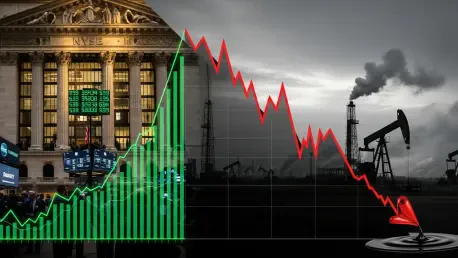
The dramatic shift we are seeing in the energy sector is a direct reflection of the diplomatic de-escalation between the U.S. and Iran. When Brent crude plummeted by 5.4% to reach $86.74 for October delivery, it signaled that the market is finally exhaling after a period of intense anxiety. Just days ago, the fear of supply disruptions pushed prices over $100 a barrel, a threshold that creates significant friction for global manufacturing and transportation. This retreat provides a much-needed buffer for the world’s economy, as the cooling of hostilities suggests that the vital energy corridors may remain more stable than previously feared.
With the Dow jumping 518 points and the tech sector leading a rally, what does the successful debut of CXMT in Shanghai tell us about the current appetite for high-value technology investments?
The equity markets are clearly finding their footing again, with the S&P 500 rising 0.6% and the Dow climbing 518 points to break a two-week losing streak. Much of this optimism is fueled by the tech sector, specifically highlighted by the staggering debut of CXMT in Shanghai, which reached an estimated market cap of 3.3 trillion yuan, or nearly $490 billion. This massive valuation, making it China’s most valuable listed company, has sent a ripple of confidence through U.S. giants like Microsoft and Alphabet, which saw gains of 2.6% and 2.8% respectively. Investors are betting that as these influential companies grow, their massive market weight will continue to steer the broader index toward a recovery.
Given that conflict in the Strait of Hormuz has previously spiked shipping costs and gasoline prices, how will the current pause in attacks impact the everyday consumer’s wallet?
The resumption of negotiations is a pivotal moment for the global supply chain, which has been under immense strain due to the restricted traffic through the Strait of Hormuz. We have seen a direct correlation where businesses pass higher shipping and gasoline costs onto households, creating a persistent inflationary sting. However, with oil prices easing, there is hope that the ripple effect of rising goods costs might finally begin to lose its momentum. If the pause in attacks holds, we could see a stabilization in the prices of basic goods, providing some relief to families who have been bearing the brunt of these geopolitical tensions.
Bond yields have started to retreat, with the 10-year Treasury falling to 4.65%. How do you see this affecting the Federal Reserve’s upcoming decision on interest rate policy?
The slight dip in the 10-year Treasury yield from 4.69% to 4.65% is a subtle but important signal that the pressure on the stock market is beginning to lift. This movement sets a cautious stage for the Federal Reserve as they prepare to provide their latest update on interest rate policy this Wednesday. Central bankers are likely looking at these falling yields alongside upcoming data on consumer confidence and inflation to determine if the economy is cooling sufficiently. While the 0.7% rise in the Nasdaq suggests optimism, the Fed’s primary focus remains on ensuring that the cooling of energy prices translates into long-term price stability across the board.
What is your forecast for the energy and equity markets as we head into the next quarter?
I anticipate a period of “cautious normalization” where the markets remain highly sensitive to any news regarding the resumption of negotiations to end the war. If Brent crude continues to hold around the $86.74 level, it will provide a stable floor for the S&P 500 to recover from its recent two-week slump. However, the true test will be the upcoming inflation report on Thursday and how the Federal Reserve interprets the balance between a booming tech sector and the high costs of international shipping. Investors should prepare for continued volatility, but the current cooling of tensions offers a narrow window of opportunity for growth.