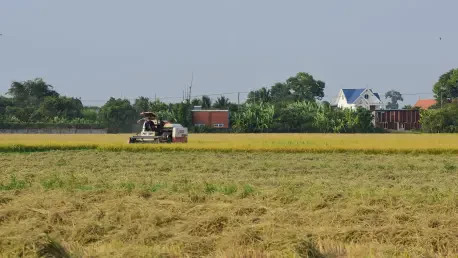

As the harvest season reaches its peak across the American Midwest, a shadow of economic uncertainty has cast itself over the traditional Republican heartland. Fifth-generation farmers who once viewed their political allegiances as ironclad are now grappling with a convergence of soaring input costs, geopolitical volatility, and a sense of growing disconnect from national leadership. With diesel prices hitting record highs and international trade tensions simmering, the political stakes for the upcoming midterms have shifted from routine incumbency to a high-stakes battle for the rural vote. Today, we are joined by Priya Jaiswal, a leading expert in American political journalism and rural economics, to explore whether the financial squeeze on the American farmer is enough to reshape the electoral map in states like Kansas, Nebraska, and Iowa.
The harvest season is often referred to as “go time” for farmers, yet this year, diesel prices have surged by over $2.50 per gallon compared to just a year ago. How is this financial pressure altering the daily operations and psychological state of producers across the Midwest?
The atmosphere on the ground right now is incredibly tense, as the physical labor of combining fields and hauling crops to town is being overshadowed by the daunting math of the ledger sheet. When you see diesel averaging $6.30 per gallon nationwide—a staggering 70% increase from where we stood at this time last year—it fundamentally changes the “go time” mentality from one of productivity to one of survival. Farmers like Glenn Brunkow in Kansas are describing this as a multi-directional assault, where every turn of the tractor engine feels like a gamble against shrinking margins. The psychological toll is significant because harvest is the one time of year when fuel consumption is non-negotiable; you cannot wait for prices to drop when the crops are ready and the winter pastures are waiting for livestock. This isn’t just about a line item on a budget; it’s about the visceral stress of watching 30% more of your revenue vanish into fuel and oil expenses alone, as projected by the USDA.
President Trump recently held a rally in Park City, asking his supporters to “pretend please that I’m on the ballot” during these midterms. Given his 16-percentage point victory in Kansas in 2024, why is there such a heavy push for voter enthusiasm in states that have been reliably red for decades?
There is a profound anxiety within the Republican establishment that the traditional “boogeyman” politics—the idea that any Democrat is a proxy for radical liberalism—is losing its punch in the face of empty pockets. Even though Donald Trump remains a titan in these regions, the reality of a 2.6% projected decline in net farm income creates a “dampened enthusiasm” that can be lethal for voter turnout. Republicans are pouring millions into states like Nebraska and Iowa because they know that a farmer who is struggling to pay for fertilizer and seed might simply stay home rather than wait in line to vote. The concern isn’t necessarily that these voters are switching parties en masse, but that the “unforced errors” of trade wars and high input costs have left them feeling exhausted and uninspired. When you see nearly $15 million being spent on a Senate race in Nebraska, a state Trump won by 20 points, it’s a clear signal that the GOP is no longer taking the rural firewall for granted.
In Kansas, Democrat Adam Hamilton is running a competitive race against Senator Roger Marshall, despite Democrats not winning a Senate seat there in nearly a century. What is it about Hamilton’s approach, or the current political climate, that is allowing a Democrat to gain traction among long-time Republican voters?
Adam Hamilton is executing a very specific, culturally resonant strategy by positioning his campaign as a “big tent” that explicitly welcomes those who voted for the President. By leveraging his background as the founder of the nation’s largest United Methodist church, he is speaking a language of community and moral pragmatism that bypasses the typical partisan vitriol. We are seeing lifelong Republicans like Debbie Geneva from Nortonville admit they are “undecided” for the first time in their lives, largely because they feel ignored by the incumbents. There is a sense that while Republican leaders are focused on national rallies, Hamilton is showing up at local markets and engaging with the reality of healthcare costs and trade agreements. When former GOP governors endorse a Democrat, it provides a “permission structure” for rural voters to prioritize their economic well-being over party loyalty, especially when they feel the current administration’s trade policies haven’t done the Midwest any favors.
The ongoing war with Iran and refinery constraints have pushed production expenses up by 4.5%. How are these global geopolitical factors complicating the domestic political narrative for rural candidates?
The war with Iran has become a double-edged sword for the Republican narrative because it simultaneously fuels the need for strong national defense while being the primary driver behind the fuel and fertilizer spikes that are crippling the farm belt. Farmers are savvy enough to see the direct line between international instability and the $6.30 they are paying at the pump, and they are starting to question the long-term cost of these global entanglements. This creates a difficult messaging environment for GOP candidates who want to project strength abroad but are facing backlash at home for the resulting “retaliatory tariffs” and supply disruptions. David McIntosh of the Club for Growth has openly acknowledged that farmers are squeezed between these higher input prices and a shrinking international market. It’s hard to sell a message of “America First” to a producer who is watching their international market share disappear because of trade disputes that show no signs of resolving.
Immigration has recently become a flashpoint in western Kansas following raids that led to the detention of over 100 people. How is this issue specifically impacting the relationship between the Republican base and party leadership in agricultural communities?
This is perhaps one of the most poignant examples of the disconnect between national rhetoric and local economic necessity. While the Republican platform often centers on border security, rural leaders like Don Hineman are pointing out that a workable immigration policy is a fundamental requirement for the American agricultural workforce. The recent raids in western Kansas have sent shockwaves through communities that depend on these workers to keep the industry moving. There is a growing frustration among GOP voters who feel that the party is playing “sycophant” to hardline immigration stances that directly sabotage the local economy. It’s a delicate balance: these voters want security, but they also want a workforce that allows their businesses to survive. When the political theater of immigration raids hits your own backyard and threatens your harvest, the “tough on crime” rhetoric starts to feel like a self-inflicted wound to the local economy.
The administration has introduced an $8 billion harvest fuel relief program and eased taxes on red-dyed diesel. In your expert opinion, are these “last-minute” interventions enough to restore the confidence of a farming population that feels the squeeze of a 30% jump in fuel costs?
While an $8 billion aid package sounds substantial, it has to be viewed against the backdrop of the $12 billion package from last December and the persistent, systemic rise in costs that these one-time payments don’t fully solve. Easing the limits on tax-free red-dyed diesel is a practical step that will save “millions” collectively, but for the individual farmer, it often feels like a bandage on a much deeper structural wound. There is a sense of “aid fatigue” where producers would much rather have stable markets and predictable fuel prices than a series of emergency executive orders. The U.S. Department of Agriculture’s forecast of a 2.6% decline in net income is a hard number to ignore, and many farmers are starting to feel that these relief programs are reactive rather than proactive. If the goal is to boost voter enthusiasm, these measures might help at the margins, but they don’t necessarily erase the “unforced errors” that led to the crisis in the first place.
What is your forecast for the midterm results in the traditional Republican strongholds of the Midwest?
My forecast for the upcoming elections in the Midwest is that we will see a significant “narrowing of the gap” that will catch many national observers by surprise. While states like Kansas and Nebraska are likely to remain in Republican hands due to their deep-seated conservative roots, the margins of victory will likely be the thinnest we have seen in decades—potentially even resulting in an upset in the Kansas Senate race if Adam Hamilton can maintain his momentum. I expect to see a “drop-off” in rural turnout by about 5-8% in key precincts, driven by the dampened enthusiasm of producers who are simply too busy or too frustrated by the $6.30 diesel prices to prioritize the trip to the polls. This shift won’t necessarily signal a permanent realignment toward the Democratic Party, but it will serve as a stark warning to the GOP that the agricultural vote requires more than just rallies and rhetoric; it requires an economic environment where the “go time” of harvest doesn’t lead to a financial dead end. The era of the “safe” 20-point margin in the heartland is, at least for this cycle, coming to a close.