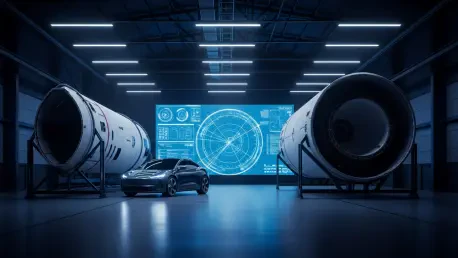

The sudden acceleration of capital toward aerospace initiatives has created a unique financial gravity that threatens to pull even the most established automotive giants into a new orbit. As SpaceX prepares for its highly anticipated initial public offering on the Nasdaq, the financial community is observing more than just a typical market debut; it is witnessing the potential birth of a multi-trillion-dollar industrial titan. With a valuation estimated at $1.25 trillion, SpaceX is no longer a speculative venture but a mature cornerstone of the global economy. This shift has ignited intense debate regarding a possible merger with Tesla, a move that would consolidate two of the most disruptive forces in modern history into a single, unified corporate empire.
The synergy between these two enterprises is becoming increasingly difficult to ignore as the lines between transportation, communications, and artificial intelligence continue to blur. A formal unification would create a corporate entity with a market capitalization exceeding $2.8 trillion, fundamentally altering the competitive landscape of the technology and manufacturing sectors. This analysis explores the core motivations behind such a merger, examining how shared infrastructure and unified leadership are driving these firms toward a common destination. By the end of this exploration, it will be clear how the upcoming IPO serves as the final prerequisite for a transaction of this unprecedented magnitude.
From Private Ambition to Public Reality: The Evolution of SpaceX and Tesla
The historical trajectory of both companies reveals a pattern of parallel development that has long suggested an eventual convergence. Tesla transformed the automotive industry by proving that electric vehicles could be both desirable and profitable, while SpaceX broke the monopoly of national agencies on space exploration through reusable rocket technology. For years, these organizations functioned as distinct branches of a broader vision, sharing a founder but maintaining separate balance sheets. However, the maturation of the space economy and the saturation of the traditional automotive market have pushed both entities to seek new avenues for growth and capital efficiency.
The transition of SpaceX from a private firm to a public one is the critical catalyst for the current merger speculation. A private valuation is often subjective, but a public listing provides a concrete, market-vetted price for shares, which is essential for any stock-swap agreement. Without this public benchmark, the fiduciary and legal complexities of merging a private giant with a public one would be prohibitive. As SpaceX enters the public markets, it brings with it a diverse portfolio including Starlink and xAI, positioning itself as a diversified technology conglomerate rather than a simple launch provider.
Evaluating the Strategic Drivers: Why a Merger Makes Sense Now
Artificial Intelligence: The Technological Bridge Between Earth and Orbit
The primary technical justification for a merger lies in the shared reliance on high-performance artificial intelligence to solve complex engineering problems. Tesla is currently deep into the development of real-world AI for autonomous driving, which requires managing immense data processing in a mobile environment with strict power and thermal constraints. Similarly, SpaceX operates in the harsh environment of orbit, where radiation and thermal cycling create existential design constraints for computing hardware. Both firms are solving the same fundamental problems: how to make machines think and act reliably in unpredictable, high-stakes environments.
Currently, both enterprises are allocating billions of dollars to AI infrastructure to maintain their competitive edge. SpaceX recently funneled over 75% of its quarterly capital expenditure into AI development, while Tesla is on a path to triple its annual research spending to nearly $25 billion. A merger would allow these firms to pool their R&D budgets, eliminating redundant efforts and streamlining the acquisition of the specialized computing power and talent needed to dominate the next decade of innovation. This unified approach would ensure that the combined entity remains at the forefront of the AI revolution, regardless of whether the hardware is on a highway or in low Earth orbit.
The Web of Operational Interdependence: Shared Human Capital and Resources
Even in the absence of a formal merger, the two companies already operate with a level of integration that is rare in the corporate world. The governance of both firms is tightly woven together, with several board members providing oversight for both entities, ensuring a unified strategic direction. This interdependence is most visible at the engineering level, where specialized materials developed for rocket fuselages have been adapted for use in high-performance electric vehicles. This cross-pollination of talent allows for a rapid exchange of ideas that would take years to achieve through traditional licensing or partnerships.
Furthermore, the companies engage in significant internal commerce that mimics the behavior of a single conglomerate. SpaceX has recently invested hundreds of millions of dollars in Tesla energy storage systems to power its massive data centers, while Tesla utilizes SpaceX’s satellite network to provide global connectivity for its fleet. The redirection of critical hardware shipments between the companies suggests that, from a leadership perspective, the boundaries between these organizations are already semi-permeable. A merger would simply codify this existing reality, reducing the administrative overhead of intra-company transactions.
Executive Power: Navigating Governance Hurdles and Control
While a merger of this scale would typically face intense regulatory and shareholder pushback, the unique concentration of voting power simplifies the path forward. At SpaceX, the leadership maintains nearly 85% of the voting power, allowing for decisive strategic shifts without the need for broad consensus. While Tesla operates under a more traditional public structure, its investor base has historically demonstrated a high degree of loyalty to the executive vision, recently approving compensation packages that align personal wealth with the aggressive expansion of the firm’s market footprint.
The legal hurdles of a merger, such as determining a fair exchange ratio for shares, remain complex but not insurmountable. Because the companies operate in different primary sectors—space and automotive—a merger is unlikely to trigger the same antitrust concerns that would plague a horizontal consolidation between two direct competitors. This lack of regulatory friction, combined with the absolute control exercised by the primary leadership, suggests that the decision to merge rests almost entirely on the strategic timeline of a single individual rather than the approval of outside stakeholders.
The Future Landscape: Shifting Toward an AI-First Industrial Conglomerate
The movement toward a unified entity signals a broader shift in the global economy away from specialized manufacturing and toward a more integrated, AI-driven industrial model. The SpaceX IPO is being marketed not just as a way to fund missions to Mars, but as the foundational layer of a global communications and intelligence ecosystem. As the space-related financial market prepares for exponential growth from 2026 to 2028, a merged “Musk Industries” would have the capital and the manufacturing scale to capture a dominant share of these emerging opportunities before competitors can react.
Economic analysts project that the integration of satellite internet with autonomous transport will create entirely new markets that do not currently exist. A unified company could offer seamless connectivity and logistics services that span the globe, leveraging its own satellite constellation and its own fleet of autonomous vehicles. This vertical integration would make it the undisputed leader in the new space economy, providing the infrastructure for a future where the distinction between terrestrial and extraterrestrial commerce becomes increasingly irrelevant.
Strategic Implications: Key Takeaways for the Modern Investor
For those navigating the current market, the potential for a SpaceX-Tesla merger highlights several essential realities. First, the importance of artificial intelligence as a unifying force across industries cannot be overstated; it is the glue that holds these disparate business models together. Second, the SpaceX IPO is the definitive financial event of the period, as it creates the liquidity and valuation framework necessary for a future transaction. Investors must stop viewing these firms as isolated businesses and start treating them as components of a single, evolving ecosystem.
Applying this insight requires a long-term perspective on the value of integrated technology platforms. Diversifying exposure across both entities may provide the best hedge against the volatility of a merger while allowing for participation in the compound growth of the combined assets. The key is to monitor for further signs of resource pooling, such as joint venture announcements or shared infrastructure projects, which will serve as leading indicators for the eventual formalization of a merger.
Closing the Loop: The Long-Term Trajectory of the Unified Vision
The analysis of the potential merger indicated that the operational and technical overlap between SpaceX and Tesla reached a point of inevitability. The movement toward a unified corporate identity was fueled by the realization that the challenges of autonomous transport and space exploration were fundamentally identical at the level of software and materials science. While the transition from two public entities into a single conglomerate presented significant administrative hurdles, the underlying financial logic proved too compelling for the leadership to ignore.
In the final assessment, the creation of a singular industrial titan served as the blueprint for the next generation of global technology firms. The consolidation allowed for an unprecedented concentration of talent and capital, which was directed toward the most ambitious projects in human history. The SpaceX IPO did not just represent a new investment opportunity; it functioned as the starting gun for a new era of corporate consolidation that redefined the limits of what a single enterprise could achieve. The resulting powerhouse stood as a testament to the power of parallel entrepreneurship and the relentless pursuit of a unified technological future.