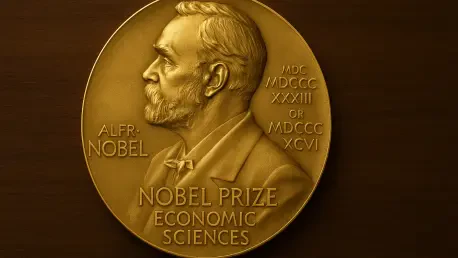

The resilience of the global financial architecture in the face of sudden geopolitical tremors or supply chain fractures depends fundamentally on the accuracy with which policymakers can anticipate human decision-making patterns. For many decades, the guardians of the world economy operated like secretive magicians, convinced that catching the public by surprise was the most effective way to steer interest rates and curb inflation. However, the announcement of the 2026 Nobel Prize in Economics has officially signaled the end of that era. This year, the Royal Swedish Academy of Sciences recognized Robert E. Hall of Stanford University and Michael Woodford of Columbia University for demonstrating that the most potent tool in a government’s arsenal is not a secret maneuver, but the ability to manage and align the expectations of the public.
This recognition marks a definitive turning point in the history of economic thought, moving away from rigid, mechanical views of the market toward a more sophisticated understanding of individual behavior. The work of Hall and Woodford provides the essential blueprints that allowed global markets to survive the high-volatility period of the mid-2020s without succumbing to the catastrophic failures of the 20th century. By establishing the “micro-foundations” of modern stability, these laureates changed how every household and business interacts with the state. Their theories have moved macroeconomic policy from a series of reactionary guesses to a proactive science centered on transparency and credibility.
Why Central Banks No Longer Operate in the Shadows
The awarding of the prize to Hall and Woodford highlights a profound transformation in how central banks communicate with the world. Historically, institutions like the Federal Reserve or the European Central Bank were notoriously tight-lipped, fearing that any leak of their intentions would lead to market manipulation or panic. Woodford’s research, in particular, dismantled this philosophy by showing that markets function more efficiently when the “rules of the game” are known in advance. When a central bank clearly signals its future intentions, it effectively anchors the expectations of millions of people, preventing the wild swings in price-setting that lead to instability.
This shift toward openness has been a primary reason why the global economy has remained surprisingly robust during the recent energy disruptions. Instead of reacting to data in the rearview mirror, central bankers now use the laureates’ models to broadcast a clear path forward, ensuring that temporary price spikes do not become permanent inflationary cycles. This “transparency doctrine” has successfully demystified the process of monetary policy, turning central bank governors from distant figures into essential communicators who prioritize clarity over shock. The consensus in 2026 is that a predictable policy is far more effective than a surprising one.
The Shift From Rigid Models to Human Behavior
The transition to modern economic governance was born out of the failure of old-school Keynesian models during the stagflation crises of several decades ago. In those years, policymakers treated the economy like a giant engine where pulling a specific lever would produce a predictable result, regardless of what people thought. When that engine stalled, it became clear that a new approach was required—one that accounted for the fact that humans are not passive participants but active forecasters. Robert E. Hall was a pioneer in this movement, shifting the focus from broad aggregates to the actual logic used by individuals when they decide to save or spend.
This focus on human behavior has allowed for a much more nuanced approach to economic management during the 2026 to 2028 fiscal period. By understanding that firms and households adjust their actions based on what they think will happen tomorrow, governments have been able to design policies that are more resilient to external shocks. This “human-centric” macroeconomics acknowledges that the economy is a collection of billions of micro-decisions, and only by understanding the foundations of those decisions can a state hope to achieve long-term stability. This approach has essentially replaced the trial-and-error methods of the past with a framework built on psychological reality.
Deciphering the Micro-Foundations of Global Stability
Robert E. Hall changed the landscape of consumer theory by introducing the Permanent Income Hypothesis, which suggests that rational people do not spend money based on their current paycheck alone. Instead, he demonstrated that individuals look at their lifetime earning potential, leading to what he termed a “random walk” in consumption patterns. This theory implies that temporary tax cuts or one-time bonuses often fail to stimulate the economy as much as expected because people simply save the windfall if they do not expect their long-term income to rise. This insight forced a massive rethink of how fiscal stimulus should be structured to be effective.
Furthermore, Hall’s later work identified a crucial divergence in the population, noting that a significant minority—roughly 20%—lives “hand-to-mouth.” These individuals do not have the luxury of forward-thinking and must spend every dollar they receive immediately to survive. This discovery provided a surgical roadmap for the most recent government interventions, allowing for highly targeted support that reaches those with the highest “marginal propensity to consume.” This ensures that every dollar of stimulus has the maximum possible impact on the GDP, a strategy that has been refined and perfected throughout the middle of this decade.
Complementing Hall’s consumer-side insights, Michael Woodford developed the “New Keynesian” synthesis, which focuses on how businesses set prices in a world of uncertainty. Woodford argued that the direction of the economy is determined by what markets think the central bank will do next year, not just the interest rate set today. His doctrine of “Forward Guidance” has become the gold standard for global finance, where governors use detailed projections to prevent panic. By managing the supply-side expectations of firms, Woodford’s frameworks have allowed the world to absorb the shocks of Middle Eastern energy spikes by using precise cooling measures rather than blunt interest rate hikes that might otherwise destroy employment.
Expert Perspectives: The Power of Expectations
The Nobel Committee emphasized that the intellectual bridge between Hall and Woodford has fundamentally altered the relationship between the state and the citizen. Experts in the field have noted that their work effectively debunked the outdated idea that there is a permanent, simple trade-off between inflation and unemployment. Because people are smart enough to anticipate policy changes, any attempt to “cheat” the system by inflating the currency only leads to higher prices without a corresponding gain in jobs. This realization has forced a level of honesty and discipline in governance that was entirely missing during the late 20th century.
These research findings have been directly credited with preventing a total financial meltdown during the most recent global fuel shortages. By practicing the “transparency over secrecy” doctrine, modern institutions have maintained the trust of the public even when costs are rising. As businesses set their prices according to the credible promises of central banks, the dreaded “inflationary bonfire” of the past has been replaced by a controlled and managed environment. The expert consensus is that policy only works when it is credible, and credibility is only earned through the consistent, research-backed communication methods championed by these two laureates.
Practical Frameworks for Modern Economic Governance
The theories of Hall and Woodford provide specific strategies that are currently employed by treasury officials and central bankers to ensure market resilience across the globe. One of the most effective applications is the use of “surgical” stimulus packages. By utilizing Hall’s data on the hand-to-mouth population, policymakers can bypass wealthy households who would simply save a stimulus check and instead direct funds toward low-liquidity groups who will drive immediate economic activity. This precision has allowed for faster recoveries from the localized downturns seen in early 2026.
Additionally, the “Transparency Protocol” derived from Woodford’s work has institutionalized a new way of managing price-setting expectations among major firms. Central banks now conduct extensive simulations to see how different demographic groups and industrial sectors will react to future shocks before they even occur. This proactive rather than reactive governance allows officials to adjust the narrative and provide the necessary guidance to keep markets calm. Instead of looking at data that is already months old, modern governance uses these micro-founded models to look forward, ensuring that the global economy remains on a steady path despite the inherent unpredictability of world events.
The Nobel Prize Committee recognized that the move toward sophisticated, behaviorally-grounded economic modeling was essential for the survival of modern financial systems. By honoring Robert E. Hall and Michael Woodford, the Royal Swedish Academy of Sciences highlighted how the transition from opaque, top-down directives to transparent, micro-level data points changed the world. The recognition solidified the shift toward a more credible form of governance that valued the psychological realities of the consumer and the price-setter alike. This award proved that when governments treated the public as rational partners rather than passive subjects, the resulting stability benefited every level of society. The foundational work of these two economists provided the tools that allowed the global community to navigate the challenges of the mid-2020s with unprecedented precision. Moving forward, the legacy of this research ensured that central banks continued to prioritize clarity and evidence-based signaling over the risky maneuvers of the past.