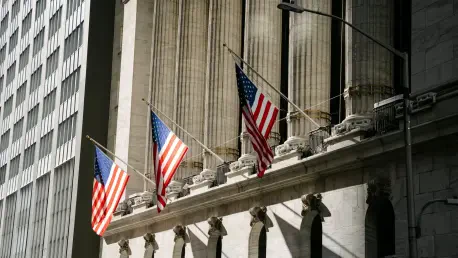

The sheer resilience of the American financial system is currently being tested by a series of contradictions that defy traditional economic modeling and challenge the assumptions of even the most seasoned traders. While the S&P 500 has surged on the back of a 30% jump in corporate earnings, the boardrooms of the nation’s largest banks are echoing with notes of caution rather than celebration. While the surface of the 2026 financial landscape looks pristine, the third-quarter earnings from the “Big Four” reveal a complex tug-of-war between immediate gains and long-term instability. The current economic momentum is fueled by a massive technological arms race, but banking leaders are increasingly concerned that the foundations of this growth are being eroded by factors that are no longer within their control.
The Paradox of Record Profits: Mounting Systemic Warnings
The third-quarter results for 2026 provide a striking visual of an economy operating at two different speeds. On one side, corporate balance sheets appear healthier than ever, buoyed by the aggressive integration of generative artificial intelligence which has streamlined operations and opened new revenue streams toward the end of this year. However, this profitability masks a growing anxiety regarding the sustainability of consumer debt and the reality of a shrinking middle-class discretionary budget.
Banking executives are now forced to reconcile these record numbers with internal data that suggests a weakening in the secondary markets. Despite the high headline numbers, the underlying sentiment in the financial sector is one of guarded preparation for a potential shift in momentum. This paradox suggests that while the momentum from 2025 has carried the market forward, the friction of high interest rates is beginning to generate heat that could eventually lead to a structural fire.
Why the Banking Sector Remains the Ultimate Economic Barometer
Understanding the health of institutions like JPMorgan Chase and Goldman Sachs is essential because their performance serves as a leading indicator for broader market trends, from consumer spending to corporate expansion. These reports provide a rare window into how high interest rates are actually impacting the ground-level economy, beyond the high-level data released by the government. As these banks navigate the transition from a period of easy money to a “higher-for-longer” interest rate environment, their internal shifts in strategy signal where the rest of the market is likely headed.
Furthermore, these institutions act as the primary gatekeepers of liquidity, and their willingness to lend or retract credit dictates the pace of innovation and housing development. When big banks begin to increase their loan-loss provisions, as seen in the recent 2026 cycles, it serves as a silent admission that the risk of default is rising among the general population. This shift in the banking appetite for risk often precedes broader economic downturns by several quarters, making these quarterly reports the most reliable crystal ball available to investors.
Analyzing the Performance Gap: The Divergence Across Financial Giants
The 2026 Q3 reports highlight a growing divergence in the sector, where specialized market focus has determined who thrives and who falters. Goldman Sachs saw a significant profit rise to $5.29 billion by capitalizing on stock-trading resilience, while Citigroup leveraged its wealth management division to achieve a 40% profit jump. These successes were largely driven by a wealthy client base that remains insulated from the inflationary pressures hitting the average consumer.
In contrast, JPMorgan Chase experienced a rare earnings miss as bond market volatility hampered fixed-income trading, and Wells Fargo’s $5.95 billion profit was tempered by a stagnation in the housing market. These variations demonstrate that while the “rising tide” of AI investment lifts some ships, the weight of a cooling real estate market and stifled mortgage originations is dragging others down. The disparity between institutions that rely on capital markets and those that rely on consumer banking has never been more pronounced than in this current fiscal year.
Expert Perspectives: Examining the “Under the Surface” Risks
Industry leaders are sounding the alarm on a convergence of macroeconomic headwinds that could disrupt the current growth cycle. JPMorgan CEO Jamie Dimon has pointed to “under the surface” factors—including massive fiscal deficits and geopolitical tensions—as primary threats to sustained prosperity. These sentiments are mirrored by the broader banking community, which is monitoring how “sticky” inflation and Treasury yield volatility are creating a precarious environment for corporate planning.
The general consensus among Wall Street executives suggests that the current era of high employment and wage growth may be living on borrowed time as government spending deficits reach critical levels. There is a palpable fear that the fiscal stimulus which bolstered the economy from 2024 through 2026 is finally losing its efficacy, leaving the market vulnerable to the gravity of its own debt. This environment has created a psychological ceiling on investment, where even the most profitable companies are hesitating to commit to massive new projects.
Strategies for Navigating: A High-Rate and Volatile Landscape
Adapting to this shifting economic terrain required a framework that prioritized liquidity and cautious capital allocation over aggressive expansion. Businesses and investors monitored the cooling housing market as a primary indicator of consumer exhaustion, especially as mortgage rates persisted above the 7% mark. Furthermore, the decision by major players like OpenAI to delay public offerings until 2027 suggested a strategic “wait-and-see” approach was becoming the new standard during election-year uncertainty. This proactive shift ensured that capital remained available for emerging opportunities in the late 2020s while shielding portfolios from the most severe inflationary spikes.
To remain resilient, stakeholders balanced the opportunities of the AI-driven technological surge with a defensive posture against the potential for sudden market corrections. Successful strategists recommended diversifying away from debt-heavy sectors and focusing on companies with high cash reserves that could withstand a prolonged period of restricted credit. This transition toward fiscal conservatism represented a necessary evolution in response to the volatile Treasury yields and global instability that defined the middle of the decade. By focusing on fundamental value rather than speculative growth, the most prepared entities found ways to preserve wealth even as systemic risks grew more prominent.