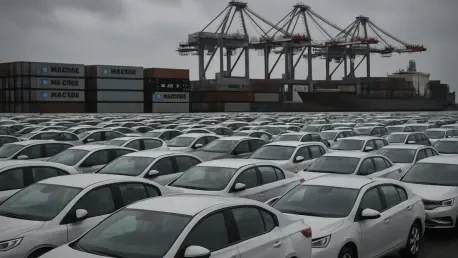

The South African automotive landscape currently presents a striking paradox where record-breaking domestic success is being met with a sudden and chilling contraction in international trade. As of February 2026, the industry finds itself navigating a high-stakes environment characterized by a decade-high peak in local showroom floors even as the shipping docks tell a much grimmer story of global rejection. This divergence highlights a fundamental shift in the sector’s health, where internal economic stabilization is finally bearing fruit, yet external vulnerabilities are mounting at an alarming rate. To understand this trajectory, one must look closely at how domestic fiscal policies and improved credit access have revitalized the local consumer, while simultaneously acknowledging how geopolitical shifts and rigid international environmental mandates are beginning to alienate South African-made vehicles from their traditional foreign strongholds.
Domestic Market Resilience and Economic Drivers
A Decade-High Milestone: Local Sales
The South African new vehicle market achieved a landmark breakthrough in February 2026, recording its strongest monthly performance since 2013 and signaling a definitive end to years of stagnation. Total domestic sales surged to 53,455 units, representing a robust 11.4% increase over the same period in the previous year, which had seen only 47,994 vehicles move off dealer lots. This growth is widely interpreted by industry analysts not as a fleeting spike driven by temporary incentives, but as a reflection of deeply entrenched domestic economic stabilization that has finally reached the retail level. The passenger car segment led this charge with an 11.3% increase, totaling 37,576 units, while the light commercial vehicle sector—encompassing the beloved local bakkies and essential mini-buses—grew by nearly 12%. This broad-based recovery across various vehicle categories suggests that both individual households and corporate entities are regaining the confidence necessary to commit to high-value, long-term assets.
Beyond the raw numbers of individual ownership, the commercial and rental sectors have provided a significant tailwind to this local momentum. The car rental industry alone accounted for 11.5% of new passenger car sales in February 2026, reflecting a sustained recovery in the tourism and business travel sectors that had been lagging since the early 2020s. Furthermore, the heavy truck and bus segment experienced a notable surge of 13.6%, reaching 1,941 units, which directly correlates with increased infrastructure spending and rising freight volumes across the national logistics network. This specific growth in heavy machinery indicates that the industrial backbone of the country is finally modernizing its fleets to meet the demands of a growing economy. The stabilization of energy security and the ongoing reforms in the national logistics chain have collectively removed many of the operational bottlenecks that previously suppressed commercial vehicle demand, allowing for a more fluid and predictable marketplace for heavy-duty transportation solutions.
Foundations: Domestic Economic Stability
The primary catalyst for this local sales momentum is a favorable shift in the broader macroeconomic environment, particularly regarding the accessibility of financing for the average consumer. A key driver has been the acceleration of private sector credit extension, which grew by 8.7% year-on-year following a series of cumulative interest rate reductions that began in late 2024 and have finally permeated the asset finance markets. These cuts have effectively lowered the monthly barrier to entry for vehicle ownership, improving buyer sentiment and allowing many who were previously priced out of the market to return to showrooms. As banks become more willing to lend under these stabilized conditions, the automotive sector has become a primary beneficiary of the increased liquidity. This environment is further supported by a 2026 Budget that prioritized fiscal credibility and debt stabilization, providing the long-term predictability that both lenders and borrowers require to engage in significant financial commitments.
Complementing the improved credit landscape is a significant cooling of the inflationary pressures that had previously eroded household purchasing power for several years. Headline consumer price inflation dropped to a manageable 3.5% in early 2026, while producer price inflation slowed even further to 2.2%, helping to moderate the aggressive price hikes that had become standard in the automotive industry. This reduction in the cost of living, combined with a stabilizing labor market where unemployment has eased to 31.4%, has created a more resilient consumer base capable of absorbing the costs of new vehicle ownership. Furthermore, the stabilization of the middle-income housing market has freed up discretionary income, allowing families to prioritize transport upgrades over essential debt servicing. The synergy between low inflation, falling interest rates, and a disciplined national budget has created a “perfect storm” of positive economic factors that continues to shield the domestic automotive retail sector from the volatility seen in the export markets.
The Growing Crisis: Export Sector
International Trade: Barriers and Protectionism
In stark and troubling contrast to the success seen at home, the South African export sector has encountered a severe and sudden contraction that threatens the long-term viability of local manufacturing plants. Vehicle exports plummeted by 28.1% in February 2026, with only 24,221 units shipped compared to over 33,000 in the same month of the previous year, representing a staggering loss of nearly 9,500 units in a single month. This decline is largely attributed to a rising tide of protectionism in key international markets, where governments are increasingly implementing restrictive trade policies and localized manufacturing incentives to protect their own industrial bases. South African-made vehicles, which once enjoyed preferential access to various global regions, are now finding it increasingly difficult to compete against domestic manufacturers in Europe and Asia who are shielded by new tariffs and non-tariff barriers designed to favor regional production over global imports.
The impact of these protectionist shifts is compounded by the fact that many of South Africa’s primary trading partners have begun to prioritize trade agreements that favor nearby geographic neighbors to reduce logistics costs and carbon footprints. As global supply chains continue to localize, the geographic isolation of South African factories becomes a significant disadvantage, especially when coupled with the higher costs of shipping from the southern tip of Africa. Furthermore, the lack of updated bilateral trade agreements that account for the new digital and green economy has left South African exporters vulnerable to changing regulations that they were not prepared to meet. This loss of international competitiveness is not merely a temporary dip but suggests a structural misalignment between South African manufacturing outputs and the evolving demands of the global trade regime, necessitating a radical rethink of how the country positions its automotive products for a world that is becoming more insular and protectionist.
The Challenge: Global Decarbonization Mandates
Beyond the purely economic barriers of protectionism, South African exporters are struggling to keep pace with the aggressive green energy mandates that are now being enforced in their most critical export destinations. Major markets, particularly in Europe, have accelerated their transition toward zero-emission vehicles, implementing stringent decarbonization requirements that South Africa’s current internal combustion engine-heavy production lines are ill-equipped to meet. As these regions move toward banning or heavily taxing non-electric vehicles, the South African industry faces an existential crisis; it must either rapidly evolve its manufacturing capabilities to include electric and hybrid vehicles or face total exclusion from its most lucrative foreign markets. The pace of this global transition has caught many local stakeholders off guard, as the infrastructure required to produce and test high-tech battery electric vehicles at scale remains underdeveloped within the borders of the Republic.
This technological gap is further widened by the fact that global automotive headquarters are increasingly allocating their “green” production mandates to factories located closer to the end-consumer or in regions with more advanced renewable energy grids. South Africa’s reliance on a carbon-intensive energy grid complicates the “well-to-gate” emissions profile of every vehicle produced locally, making them less attractive to international buyers who are under pressure to report lower scope-three emissions. To remain a relevant player in the global automotive supply chain, South African manufacturers must navigate a complex transition that requires massive capital investment in green technology while simultaneously maintaining the efficiency of their existing operations. Without a coordinated national strategy to integrate renewable energy into the manufacturing process and provide incentives for electric vehicle components, the export sector risks a permanent decline as the world moves toward a post-carbon automotive era that currently seems out of reach for local plants.
Emerging Risks and Operating Costs
Rising Total: Cost of Vehicle Ownership
While the initial purchase price of vehicles has been somewhat stabilized by lower inflation, the emerging threats related to the total cost of ownership are beginning to weigh heavily on the long-term outlook for the market. The 2026 Budget confirmed significant hikes in fuel levies that took effect in April, including a 9-cent per liter increase for petrol and an 8-cent increase for diesel, alongside higher contributions to the Road Accident Fund and carbon fuel levies. These domestic policy adjustments, while necessary for fiscal health and infrastructure maintenance, add a persistent layer of financial pressure on every kilometer driven. For commercial fleets and logistics companies, these incremental increases aggregate into substantial operational overheads, which are invariably passed down to the consumer in the form of higher goods prices, potentially reigniting the inflationary cycle that the country has worked so hard to dampen.
Furthermore, the shift toward higher “green” taxes on older or less efficient vehicles is beginning to influence the secondary market, which in turn affects trade-in values for new car buyers. As the government seeks to align its tax code with global environmental standards, the cost of licensing and maintaining traditional internal combustion vehicles is expected to rise steadily over the next few years. This creates a psychological barrier for consumers who may be hesitant to commit to a new vehicle if they anticipate that the future cost of running that vehicle will become prohibitively expensive. The “total cost of ownership” narrative is shifting from a focus on the monthly installment to a more holistic view that includes insurance, fuel, carbon taxes, and maintenance in a volatile energy environment. For the South African market to sustain its current growth, manufacturers and policymakers will need to find a way to offset these rising operational costs, perhaps through more aggressive fuel-efficiency standards or localized incentives for low-emission transport.
Geopolitical Volatility: Energy Security
External factors such as ongoing geopolitical instability in the Middle East have introduced a level of energy insecurity that threatens to undermine the recent gains made in consumer affordability. Recent military operations and regional tensions have pushed Brent crude prices consistently above the $80-per-barrel mark, which translates directly to higher pump prices in South Africa due to the country’s status as a net oil importer. This volatility is compounded by the vulnerability of key maritime routes, such as the Strait of Hormuz, which handles a significant portion of the world’s daily oil supply. Any disruption in these global arteries leads to immediate price spikes at the local level, creating an inflationary impulse that the South African Reserve Bank may eventually have to counter with higher interest rates, thereby reversing the very credit conditions that have fueled the recent 2026 sales boom.
The sensitivity of the local automotive market to global energy shocks is further exacerbated by the continued depreciation of the South African rand, which has faced significant pressure due to a global “risk-off” sentiment among investors. Trading at approximately R16.16 to the US dollar, the weaker currency makes the importation of crude oil and essential automotive components significantly more expensive. This currency-driven inflation acts as a hidden tax on the industry, raising the floor for manufacturing costs and retail prices simultaneously. Even if domestic demand remains high, the cost of supplying that demand is increasingly dictated by factors far beyond the control of local manufacturers or policymakers. As the industry looks toward the remainder of the decade, the ability to insulate the local market from these external energy shocks—perhaps through a more rapid adoption of localized energy production or alternative fuel sources—will be a defining factor in maintaining the current upward trajectory of the domestic automotive sector.
Future Outlook and Strategic Adaptation
Balancing Local: Growth and Global Pressures
The consensus regarding the South African automotive market as it moves through 2026 is one of cautious optimism that is heavily tempered by the harsh realities of a changing global order. While the domestic retail sector has proven its resilience, supported by a stabilizing labor market and improved access to financing, the industry stands at a critical crossroads where it can no longer rely on its internal success to mask external failures. The strength of local dealers and the double-digit growth in bakkie and passenger car sales demonstrate that there is a healthy appetite for mobility within the country. However, the sharp decline in exports serves as a clear warning that the traditional model of being a low-cost manufacturing hub for the world is under immediate threat from both technological shifts and political isolationism.
Strategically, the industry must now pivot to a dual-track approach that nurtures domestic growth while aggressively reforming its export profile to match the new global reality. This involves not only maintaining the current momentum in the retail sector through competitive financing and stable pricing but also engaging in high-level trade diplomacy to secure new markets and protect existing ones. The industry must find ways to leverage its local strengths—such as its deep expertise in right-hand-drive manufacturing and its established supply chains—to diversify its export destinations beyond the increasingly restrictive European and North American corridors. By exploring burgeoning markets in Africa and South America that may have a slower transition to full electrification, the South African automotive sector can buy the time it needs to perform the deep structural upgrades required for a truly green future without sacrificing its current manufacturing volumes.
The Urgent: Need for Structural Evolution
In the final analysis, the South African automotive industry’s performance in February 2026 was a testament to the country’s internal economic recovery, yet it simultaneously exposed a profound vulnerability to international trends that cannot be ignored. The record-high domestic sales figures were driven by disciplined fiscal policy and a cooling inflationary environment, providing a necessary lifeline to an industry that has faced years of headwinds. However, the collapse of export volumes and the looming pressure of global decarbonization mandates indicate that the current manufacturing status quo is reaching its expiration date. To remain competitive, stakeholders must transition from a reactive posture to a proactive strategy that prioritizes the modernization of local plants and the integration of renewable energy into the production process.
Looking ahead, the success of the sector will likely depend on its ability to implement a rapid structural evolution that satisfies international environmental benchmarks while continuing to support the recovering domestic consumer base. This will require a coordinated effort between the government and the private sector to incentivize the production of electric vehicle components and to upgrade the national logistics infrastructure to lower the cost of reaching global markets. While the challenges of high oil prices, currency weakness, and protectionism are formidable, the industry’s ability to achieve a decade-high sales peak amidst such volatility suggests a fundamental core of resilience. The next steps must involve turning that resilience into a sustainable competitive advantage by embracing the technological shifts that are currently being viewed as threats. By doing so, South Africa can ensure that its automotive sector remains a cornerstone of the national economy for the remainder of the decade and beyond.