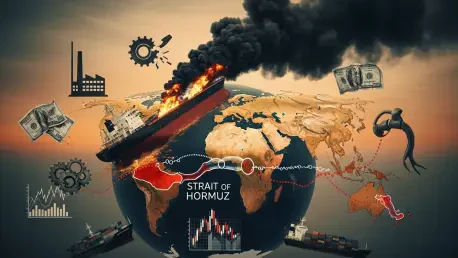

A single decision to police a 33-kilometer-wide waterway that carries roughly a fifth of the world’s oil threatened to convert a tactical show of resolve into a standing risk to global finance, energy security, and diplomatic order. By shifting from sanctions and indirect pressure to direct enforcement at the Strait of Hormuz, the United States signaled that it was prepared to leverage geography as coercion, but it also accepted liabilities that are famously hard to cap, cost out, or unwind. The logic seems straightforward—tighten the screws on Iranian revenue and logistics, deter harassment, and reassure partners that the Gulf remains navigable—but the operating reality is not. Chokepoints magnify both power and peril. They offer fast leverage to actors willing to play for disruption, while forcing stronger navies to bleed resources defending thin margins of safety. Markets, insurers, and rival powers react in hours, not months, and their responses propagate through shipping routes and exchange rates with a speed that defies careful calibration. That dynamic is already visible in elevated risk premia on Gulf transits and nervous hedging in energy futures.
The Chokepoint Gamble
Strategic Misread at Hormuz
Treating Hormuz like a pressure valve to be opened or closed on demand underestimated how little coercive leverage a blockade actually delivered once the broader system shouldered the cost. The comparison with sanctions against Venezuela or Cuba is instructive precisely because it fails: those measures targeted economies with limited systemic reach, allowing Washington to calibrate pain without endangering the world’s energy metabolism. Hormuz is different. Tankers transiting its narrows supply refiners in Asia, Europe, and, through swaps and arbitrage, markets far beyond. A move meant to punish Tehran also penalizes allied energy importers, neutral traders, and shipping lines that neither caused nor controlled the dispute. Within days, underwriters raise war-risk premia, charterers demand diversion clauses, and shipowners reassess tonnage deployment. The cumulative effect is diffuse yet potent—less available capacity, higher costs, and a political backlash that extends well beyond the intended target.
Moreover, the blockade’s selective targeting of “Iranian-linked” shipping created ambiguity that global markets tend to price as worst-case risk. Flag, ownership, cargo origin, and beneficial control often tangle across jurisdictions; a Libya- or Russia-era lesson is that enforcement frictions translate into delays and detentions that are expensive even when brief. In practice, distinguishing between illicit facilitation and legitimate trade requires granular intelligence and legal stamina, both of which are scarce in real time on the high seas. That uncertainty becomes leverage for adversaries and frustration for partners. Gulf exporters field urgent requests for guarantees; Asian refiners seek alternative liftings; and spot charters spike as vessels queue for inspections or rerouting. The strategy’s premise—limited pain for maximum political yield—thus collides with a marketplace that punishes ambiguity and distributes costs widely, eroding support from precisely the states whose cooperation is essential to sustain pressure.
How Blockades Spiral
Physical enforcement at a strait introduces a credibility trap that textbooks describe but policymakers often discount. Once a navy asserts the right to halt, board, or redirect vessels, any retreat absent visible gains invites tests from adversaries and awkward questions from allies about staying power. Yet maintaining the posture over time inflates exposure. Iran possesses a repertoire of calibrated ripostes: rocket and drone harassment, fast-boat swarms shadowing convoys, and, critically, proxy-enabled interference along linked corridors. The Sea of Oman sits next door; the Bab al-Mandab, long within Houthi reach, shapes Red Sea insurance and schedules on Asia–Europe lanes. Each tit-for-tat that leaves the other side “something to prove” tightens the coil of escalation. What begins as a limited blockade morphs into an open-ended policing mission with mine countermeasures, air defense, and convoying requirements that ratchet up with every incident.
This spiral grows more constraining as sunk political costs accumulate. Domestic audiences in multiple countries watch for resolve; rivals probe for weak seams; and partners press for outcome metrics that are hard to show at sea. Absent a negotiated off-ramp, the United States faces a bad choice set: escalate to impose order, risking a broader war and sharper energy shock, or relax enforcement and accept reputational dents that adversaries will brandish as vindication. Meanwhile, Iran’s calculus stays asymmetric. A single scuttled barge in a channel, a cluster of inexpensive naval mines, or a volley of anti-ship missiles from concealed launchers can impose delays and insurance spikes far out of proportion to the cost of the act. The blockade holder spends heavily just to keep the waterway barely safe; the challenger spends lightly to keep it perpetually in question.
Lessons from History
Historical cases illuminate why chokepoint coercion so rarely delivers neat wins. During the 1984–88 Tanker War, attacks and reflagging drew the United States deeper into escort operations and mine clearing, culminating in clashes like Operation Praying Mantis. The strait never fully “closed,” yet the economic and military costs climbed while political outcomes remained mixed. In the 1956 Suez Crisis, efforts to control passage precipitated invasion, international censure, and a hard diplomatic settlement that redefined influence in the region. More recently, Houthi strikes in the Red Sea since 2023 demonstrated how harassment of select ship classes can reorder shipping lanes without outright blockades, pushing carriers to round the Cape of Good Hope and absorb weeks of delay. In each case, maritime friction widened conflicts or forced accommodation, rather than producing decisive capitulation by the target.
What links these episodes is not simply geography but the economic logic baked into narrow seas. When threats materialize at a chokepoint, shippers diversify routes, insurers reprice coverage, and ports re-sequence schedules; the system adapts, but at considerable cost. That cost lands on consumers and treasuries worldwide, generating political incentives for negotiated relief even when militaries still jockey on the water. The track record suggests a reliable pattern: force may pry open a lane temporarily, but durable stability typically returns only through settlements acceptable to the broad set of stakeholders who rely on the passage. That should caution against strategies that predicate success on indefinite coercion at a maritime bottleneck, because the longer the strain persists, the stronger the coalition lobbying for compromise becomes.
Escalation Pathways and Actors
A Multi-Front Contest
Hormuz does not exist in isolation; energy and shipping networks bind it to other narrow corridors where pressure can be applied at low cost. As enforcement tightened in the Gulf, friction migrated—first to the Sea of Oman, then across to the Bab al-Mandab and the Red Sea, where Houthi capabilities had already raised risk for container and tanker traffic. Naval planners now reckon with composite threats: a mine discovered near Fujairah; an anti-ship drone intercepted over the Gulf of Aden; a suspicious approach by fast boats inside the strait’s traffic separation scheme. The operational response—convoying high-value cargoes, rotating Aegis destroyers for air defense, deploying MH-60s for surface surveillance, and surging mine countermeasure assets—spreads forces thin along elongated sea lines. Every added mile of guarded water amplifies opportunity for mishap and miscalculation, a reality that erodes the clean deterrent story blockades often promise at the outset.
Horizontal escalation also invites actors with divergent agendas. Gulf monarchies reliant on steady exports may back visibility and force, yet grow uneasy if prices and insurance surge past tolerance levels. European states dependent on Suez for containerized trade—already contending with Cape diversions—push for de-escalation to protect supply chains. Meanwhile, non-state groups sympathetic to Tehran look for low-cost signals of defiance, ranging from drone fly-bys to GPS spoofing near approaches. The multiplication of stakeholders complicates any coalition of enforcement. Rules of engagement must satisfy lawyers and politicians across capitals; intelligence sharing must balance security with transparency; and the inevitable accident or misfire becomes a diplomatic incident that opponents can exploit. As fronts proliferate, off-ramps narrow, because any concession in one corridor is quickly tested in another.
China’s Exposure and Great-Power Friction
China’s energy security adds a combustible layer to the picture. A significant share of its crude and LNG imports sails through Hormuz and, for Europe-bound trade, the Red Sea. Disruptions therefore map directly onto Chinese industrial output, inflation, and social stability concerns. Beijing’s condemnation of heightened interdictions and its messaging on trade stability were not mere rhetoric; they signaled a readiness to defend commercial throughput and to scrutinize any practice that looks like selective denial of navigation rights. If an inspection halts a Chinese-flagged tanker or a time-sensitive cargo with Chinese ownership ties, diplomatic protests would likely escalate rapidly, potentially pairing with economic countermeasures in unrelated arenas, from rare earths to regulatory pressure on Western firms. That linkage risk transforms a regional contest into a mechanism for broader strategic bargaining that neither side may want but both could stumble into.
Beyond rhetoric, China has options that complicate the blockade environment. It can deepen financial and logistical support to Iran—clearing more transactions in renminbi, expanding ship-to-ship transfers beyond typical hubs, or steering state-owned traders toward cargoes that test enforcement red lines. It can also augment Gulf presence through port calls, anti-piracy task force rotations, and intelligence cooperation framed as “commercial security.” Each of these steps raises the odds of on-water encounters where misinterpretation has outsized consequences. Even if navies adhere to the Code for Unplanned Encounters at Sea, an aggressive hail, a helicopter flyover, or a slow-to-respond AIS transponder could turn into a nationalistic flashpoint. In effect, the blockade creates a tripwire not just with Iran and its partners but with a major power whose domestic stability depends on predictable maritime flows.
Economic, Legal, and Technological Fallout
Shock Transmission to Markets
Chokepoint risk travels at the speed of maritime insurance and futures screens. Within days of credible enforcement, war-risk premia rise for tankers entering the Gulf, time-charter equivalents for VLCCs and Suezmaxes jump, and bunker suppliers adjust prices to reflect detours and idling. A single rerouting from the Red Sea to the Cape of Good Hope can add more than a week to Asia–Europe transits, consume thousands of additional tons of fuel, and tie up vessels that would otherwise relieve congestion elsewhere. Refiners with tight crude slates scramble to swap barrels, drawing on inventories or bidding up spot cargoes from West Africa, the North Sea, or Brazil. LNG importers confront a similar calculus: charter day rates spike, and the reliability of delivery windows erodes. The inflationary impulse arrives via pump prices, electricity tariffs, and goods that depend on just-in-time shipping, squeezing central banks already wary of second-round effects.
Strategic buffers help, but only at the margin. Coordinated releases from strategic petroleum reserves can dampen front-month price spikes; emergency waivers on sulfur caps or cabotage rules can ease logistics; and temporary subsidies can cushion household bills. Yet none of these measures unlocks constrained passages or clears a backlog of hulls waiting on inspections. The structural constraints—narrow waterways, finite tug and pilot capacity, and heightened caution under threat—impose a ceiling on throughput that macro policy cannot lift. As days stretch into weeks, treasury officials confront tradeoffs between inflation control and growth support, while business leaders delay investment on uncertainty about energy and freight costs. Credit spreads widen for exposed sectors like airlines, chemicals, and heavy industry, translating the maritime shock into financial ripples that policymakers cannot ignore.
Law, Diplomacy, and Tech Limits
Legal arguments around blockades, visit-and-search rights, and neutral shipping rarely yield clear winners in real time. Proponents cite self-defense, UN resolutions, or customary law to justify interdictions; opponents invoke freedom of navigation, due process for cargo verification, and the rights of neutrals to trade. Even when legal footing is firm, coalition politics introduces friction. European partners might demand narrower target lists and stricter evidentiary standards; Asian importers might push for guaranteed transit for non-military cargoes with verifiable end users. Each additional safeguard complicates execution at sea and lengthens boarding times, raising costs and risks. Adversaries seize on any inconsistency—an overbroad halt here, a missed suspect there—to mount diplomatic campaigns that brand enforcement as arbitrary or discriminatory, eroding the legitimacy vital to sustain long operations.
Technology promises sharper awareness but cannot neutralize the chokepoint dilemma. AI-powered vessel behavior analytics, fusing AIS, SAR imagery, and high-frequency radio data, can flag deceptive routing and dark activity more quickly than human watchstanders. Unmanned surface and aerial vehicles extend patrol coverage, and seabed sensors detect acoustic anomalies that hint at mine-laying. These tools improve cueing and shorten the loop from detection to interdiction. Yet they do not sweep channels of influence mines at scale, guarantee a tanker’s safe passage under anti-ship missile threat, or repair the fundamental asymmetry that favors the disruptor. Countermeasures—AIS spoofing, decoy drones, and low-cost glide munitions—evolve in parallel. The result is a technological arms race that raises budgets and expectations without delivering the strategic certainty policymakers seek. In other words, sensors can see trouble sooner; they cannot make geography less decisive.
Toward De-Escalation: Practical Next Steps
A sustainable path out of the blockade cycle hinged on creating credible off-ramps that preserved deterrence while relieving systemic pressure. That required shifting the center of gravity from blanket enforcement to targeted risk reduction and diplomacy. Practically, that meant time-bound inspection regimes run by a multilateral maritime tasking cell with transparent criteria; pre-cleared “green lanes” for vetted carriers and LNG shuttles under neutral escort; and a standing Gulf–Red Sea incident hotline that included Tehran, Gulf states, and external powers to defuse ambiguous contacts at sea. It also meant pairing sanctions relief tranches with verifiable steps: mine countermeasure cooperation through third parties, cessation of specific missile or drone deployments near traffic separation schemes, and verifiable limits on proxy activity around Bab al-Mandab. Financial architecture mattered as well. Expanding escrow-based oil payments and renminbi or euro clearing for humanitarian and non-sanctioned trade would have reduced incentives to test the blockade. Finally, a clear sunset clause—stating conditions and a timeline from this year to the next under which enforcement would ratchet down—helped align partners and deny adversaries an open-ended narrative of occupation. Policymakers who adopted those measures preserved leverage while cutting the odds that Hormuz enforcement would metastasize into a global economic shock.