
Priya Jaiswal is a distinguished figure in the world of global finance, renowned for her sharp analytical mind and deep understanding of market mechanics. As a leading expert in portfolio management and international business trends, she has spent years navigating the complexities of banking and equity markets. In today’s discussion, we explore the recent turbulence in the U.S. stock market, the meteoric rise of artificial intelligence heavyweights, and the geopolitical factors currently swaying energy prices and interest rate expectations. From the strategic pivots of telecom giants to the critical role of Treasury yields, Jaiswal provides a masterclass in interpreting the numbers that drive Wall Street.
Applied Materials recently climbed over 10%, yet many AI-focused firms face intense scrutiny regarding their earnings sustainability; how do you interpret this divergence in investor confidence?
The recent 10.8% rally in Applied Materials is a testament to the specialized role semiconductor equipment makers play in the broader ecosystem, pushing its year-to-date gains above a staggering 170%. While the broader AI sector has been on a gut-wrenching roller-coaster ride, investors are clearly distinguishing between the companies providing the physical tools for innovation and those whose valuations are driven by speculative future profits. We are seeing a palpable tension on Wall Street where firms like Nvidia, now valued at over $4.7 trillion, carry so much weight that their 1.3% fluctuations can dictate the direction of the entire S&P 500. There is a lingering fear that corporate profits simply cannot keep pace with these towering stock prices, leading to the “pressure” we saw during the recent five-day losing streak. It feels like a high-stakes game where every earnings report must be a home run just to justify the current entry price.
With SpaceX and its xAI business reaching a $2 trillion valuation, what does its upcoming inclusion in the Nasdaq 100 signal for institutional investors?
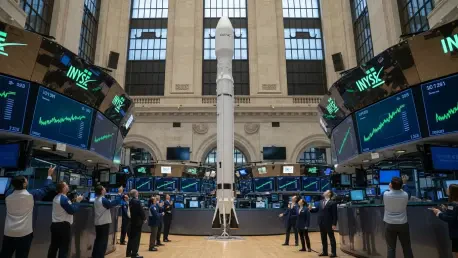
SpaceX has undergone a truly ballyhooed debut, and its 7.2% jump recently reflects the sheer gravity Elon Musk’s ventures exert on the market. By joining the Nasdaq 100 index on July 7, the company is effectively forcing the hand of institutional funds that track the index, as they will be required to buy the stock regardless of the recent sharp rises and falls. Seeing a private-turned-public entity hit a $2 trillion valuation so rapidly creates a sense of urgency among investors who don’t want to miss the next industrial revolution. However, the volatility we’ve witnessed along the way serves as a sobering reminder that even the most innovative rockets can face turbulent atmospheric conditions on the trading floor. This inclusion is a structural milestone that solidifies AI and aerospace as the new pillars of the American tech landscape.
Comcast and Verizon took very different strategic paths recently; how are these corporate restructurings and joint ventures reshaping the telecommunications landscape for investors?
The divergence between these two giants was striking, with Comcast climbing 4.5% after announcing a bold plan to split off its NBCUniversal media business and Sky from its core connectivity operations. This move was a necessary jolt for a stock that had been languishing with a 17.3% loss for the year, as it allows the market to value the high-growth media assets separately from the steadier broadband business. Conversely, Verizon saw a 5.2% drop after committing to a $625 million deal to merge its international wireline services with BT Group’s subsidiaries in a new joint venture. Investors often react with skepticism to large cash outlays and complex international integrations, especially when the immediate benefits to the bottom line are obscured by the fog of restructuring. It illustrates a broader trend where companies are being forced to choose between streamlining their focus or expanding their global footprint through costly partnerships.
Energy prices remain a major wildcard for global inflation, so how is the geopolitical situation in the Persian Gulf specifically dictating the Federal Reserve’s next moves?
The spike in Brent crude to $73.91 per barrel is more than just a number; it represents a punishing wave of inflation that threatens to wash away the progress made by central banks. The market is currently holding its breath for an end to the conflict with Iran, which would ideally restore full access to the Strait of Hormuz and allow tankers to move oil out of the Persian Gulf without fear. If benchmark U.S. crude, which settled at $70.75, can stabilize or recede, it gives the Federal Reserve the breathing room they desperately need to keep interest rates steady or even consider a cut. High yields have been rattling investors’ nerves, particularly after oil previously burst above the $100 mark, so every cent of movement in energy prices is being watched with an almost visceral intensity. We are in a period where a diplomat’s words in the Middle East can carry more weight for the S&P 500 than a CEO’s quarterly guidance.
What is your forecast for interest rates and the broader market?
I believe we are looking at a period of cautious stabilization, provided that the 10-year Treasury yield continues its descent from the 4.56% highs we saw earlier this month toward the current 4.37% level. The S&P 500’s recovery to 7,440.43 points shows that there is still plenty of liquidity and “buy-the-dip” mentality in the market, but the era of easy, broad-based gains is likely behind us. My forecast is that the Federal Reserve will remain in a holding pattern until they see a definitive cooling in energy-driven inflation, which means investors should prepare for more sideways trading and sector-specific volatility. Success in the coming months will belong to those who can look past the 522-point rallies in the Nasdaq and identify the companies with the actual infrastructure to sustain their massive market caps.