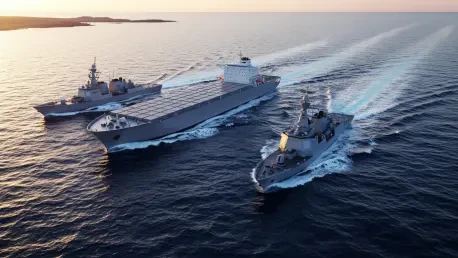

The relentless thunder of cruise missiles across the Gulf of Aden has shattered the long-standing illusion that the shadow war between regional titans could remain confined to the dark corners of the Arabian Peninsula. While the Red Sea has served as a theater of tension for years, the current shift from proxy engagements to direct military action signals a definitive end to the era of containment. Washington and Riyadh are no longer content with localized skirmishes, moving instead toward a realignment of strategic force.
The Sudden Pivot Toward Total War in the Middle East
The disabling of the merchant vessel M/T Lavine in the Gulf of Oman and a 13-night aerial campaign against Iranian assets demonstrate a new level of aggression. This transition suggests that major powers are stepping out from behind their intermediaries to face one another directly on the battlefield. Instead of managing shadow boxing, the coalition is now engaged in high-intensity operations designed to dismantle threat networks at their source.
This departure from traditional containment marks a transformation in regional military doctrine. The persistent bombing of tactical infrastructure indicates that the tolerance for maritime disruption has reached a breaking point. Strategic planners are moving toward a framework where direct engagement is considered the most effective way to address the growing instability across the Middle East.
Why the Bab el-Mandeb Strait and Global Energy Corridors Dictate the Conflict
The survival of global energy markets and the integrity of maritime trade dictate the pace of this escalation. When Houthi militias declared a maritime embargo, they targeted the jugular of international commerce: the Bab el-Mandeb Strait. Securing refineries in Yanbu has become a global necessity rather than just a local military objective, as these sites are essential to the world’s fuel supply chain.
The failure of diplomatic containment forced the U.S. and Saudi Arabia to abandon passive defense in favor of kinetic intervention. Protecting these chokepoints is now viewed as an existential requirement for global economic stability. Without secure shipping lanes, the risk of a systemic collapse in trade has driven the major players toward more aggressive and direct military postures.
Retaliatory Strikes, Naval Blockades, and the Breakdown of Maritime Security
Saudi Arabia has moved beyond localized defense by coordinating with international partners to man advanced air defense systems. This strategy includes massive retaliatory strikes against military targets in Yemen to neutralize ballistic threats before they reach critical infrastructure. These coordinated efforts are designed to ensure that the costs of aggression are felt immediately by those disrupting the regional balance.
The United States has simultaneously shifted to a posture of maximum pressure through a sustained bombing campaign and a strict maritime blockade. By disabling vessels like the M/T Lavine, the U.S. military is preventing interference with commercial shipping while cutting off supply lines. These actions represent a multi-front effort to hold those responsible for regional chaos accountable through direct force.
Expert Perspectives on Accountability and the Failure of Deterrence
Military leaders emphasize that the old rules of engagement are no longer viable in the current environment. Major General Turki Al-Malki has characterized the ongoing strikes as essential measures for protecting global energy corridors and enforcing international law. This perspective highlights a shift toward personal accountability for state actors who utilize proxies to achieve their geopolitical goals.
President Donald Trump has sharpened this stance by identifying the Houthis as direct instruments of Iranian policy, asserting that Iran will be held responsible for every tanker threatened. This reflects a consensus among defense experts that previous efforts to mitigate conflict through indirect pressure have failed. Direct military action is now seen as the only path forward to restore a credible deterrent in the region.
Strategic Frameworks for Security and the Path Toward De-escalation
The strategy utilized a three-part framework to stabilize the region: rigid maritime blockades, multi-national air defense partnerships, and neutral mediation. Pakistan acted as a vital intermediary, seeking to restart peace talks between the primary belligerents while military pressure was maintained. This approach aimed to keep a narrow window for diplomacy open while ensuring that the infrastructure of maritime trade remained protected.
The implementation of a massive attack contingency served as the final tool for persuading the opposition to return to the negotiating table. The coordinated military response prioritized the protection of energy security, ensuring that global fuel supplies remained intact during the transition. Ultimately, these actions established a new precedent for regional security, focusing on direct accountability to prevent further escalation.