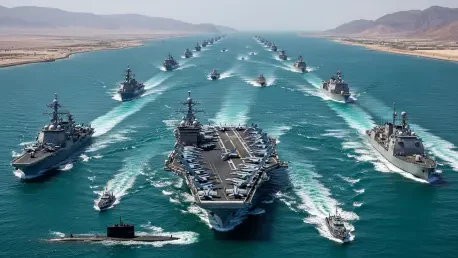

Priya Jaiswal brings a wealth of strategic insight into the intersection of high-stakes geopolitics and international finance, a perspective that is more critical than ever as global markets grapple with unprecedented volatility. As the United States Navy begins its blockade of the Strait of Hormuz, driving crude oil prices well past the $100-per-barrel mark, the world is watching to see how supply chains and investor sentiment will adapt. This discussion explores the cascading effects of energy shortages, the shifting political landscape in Eastern Europe, and the aggressive tariff strategies reshaping trade relations between the West and Asia.
With the U.S. Navy now blockading the Strait of Hormuz and crude oil prices climbing past $100 a barrel, what immediate operational risks do global energy suppliers face?
The immediate risk is a total paralysis of the primary artery for global energy, as the blockade that began at 10 a.m. Monday effectively chokes off the flow of Iranian oil. Suppliers are now forced to navigate the “illegal act of extortion” described by the U.S. administration, which has sent a shockwave through the shipping industry and pushed crude oil past that psychological $100 threshold. Logistics firms must immediately pivot to longer, more expensive alternative routes, often bypassing the region entirely to avoid the naval exclusion zone, which increases transit times and insurance premiums exponentially. We are looking at metrics like the 2% surge in Norwegian oil giant Vår Energi as a clear signal that the market is already pricing in a long-term shift toward non-Middle Eastern energy sources to ensure regional security.
Jet fuel supply concerns are putting significant pressure on major European carriers and aircraft engine manufacturers, leading to sharp declines in stock value. What hedging strategies can airlines implement to survive these price spikes, and what are the cascading effects on international tourism if fuel shortages persist?
Airlines are currently in a defensive crouch, with Wizz Air dropping 5.4% and Lufthansa sliding 2.3% as the reality of fuel scarcity hits the bottom line. To survive, carriers must lean heavily into aggressive fuel derivatives and long-term supply contracts, though many are already feeling the sting of being under-hedged during this sudden $100 oil surge. If these shortages persist, the tourism sector will see a painful contraction; we already see Tui down 1.7%, reflecting a growing fear that holiday travel will become prohibitively expensive for the average consumer. Even high-end manufacturers like MTU Aero Engines are feeling the pressure, showing that the entire aviation ecosystem is vulnerable to these violent shifts in energy availability.
Global trade tensions are escalating with threats of 50% tariffs on nations providing military assistance to Iran. How do these massive tariffs alter the manufacturing landscape in Asia, and what steps should multinational corporations take to decouple their supply chains from high-risk geopolitical zones?
The threat of “staggering tariffs” of 50% against China represents a fundamental rewriting of the trade rules we have lived by for decades. This forces a frantic acceleration of “friend-shoring,” where corporations must move their manufacturing bases out of high-risk zones and into more politically aligned territories to avoid being caught in the crossfire of U.S.-Iran tensions. For a multinational corporation, the first step is a cold, hard audit of every sub-supplier to ensure they aren’t utilizing Chinese air defense components or arms that would trigger these massive penalties. It is a logistical nightmare that involves moving billions in capital, but the risk of a 50% tax on goods makes the status quo entirely unsustainable.
Hungary is experiencing a major political shift toward pro-EU leadership, leading to a significant rally for the forint against the dollar and euro. What does this transition mean for regional stability, and how should investors reevaluate their risk models for emerging markets in Eastern Europe?
The landslide victory of Peter Magyar’s Tisza party over Viktor Orban marks a seismic shift that has sent the forint rallying 2.51% against the dollar, reaching a level of 313.7. For investors, this is a clear signal that the “Eurosceptic risk” in Hungary is receding, making the region far more attractive for long-term capital that previously feared a rupture with Brussels. You can feel the sense of relief in the markets as the forint also strengthened 2.42% against the euro, suggesting that regional stability is being restored after years of friction. Risk models must now be updated to account for this democratic pivot, recognizing that political alignment with the EU can provide a powerful cushion against the volatility seen elsewhere in the world.
Following the breakdown of diplomatic negotiations and the subsequent dip in major global indices, market volatility is rising. What specific indicators should traders monitor to gauge market resilience, and how can they distinguish a temporary downturn from a broader, more permanent economic correction?
Traders need to keep a laser focus on the major indices like the Dow, which fell 247 points, or 0.5%, immediately following the breakdown of Washington-Tehran talks. Resilience can be gauged by how sectors like luxury goods—think LVMH and Christian Dior—hold up during these earnings releases, as they often serve as a bellwether for global consumer confidence. A temporary downturn usually sees a quick recovery in the S&P 500, which remained relatively flat today, whereas a permanent correction is marked by a sustained decline across all sectors simultaneously. The key is watching whether the energy-led inflation begins to erode the margins of non-energy companies over multiple trading sessions, rather than just a single-day reactionary dip.
What is your forecast for global energy markets over the next quarter?
The outlook for the next quarter is one of sustained high prices and extreme volatility as the blockade of the Strait of Hormuz creates a structural deficit that cannot be easily filled. I expect crude oil to maintain its position well above $100 as the market prices in the “prolonged conflict” that investors are currently fearing. We will likely see a widening gap between energy-producing nations and energy-dependent economies, with a continued premium placed on secure, Western-aligned oil and gas assets. Until a new diplomatic path is forged between the U.S. and Iran, the energy sector will remain the primary driver of global market uncertainty, keeping pressure on everything from manufacturing to travel.