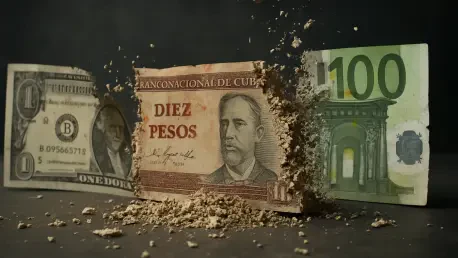

The rapid depreciation of the national currency reflects a systemic shortage of foreign cash within official banking channels and a desperate attempt by the population to protect their wealth against rampant inflation. As October 2026 unfolds, the financial reality in Havana has reached a critical juncture where the Cuban Peso (CUP) is effectively being abandoned in favor of more stable foreign denominations. The informal market, which now dictates the prices of nearly all essential goods, has seen the American dollar surge to 785 CUP while the euro has climbed even higher to a staggering 880 CUP. This is not merely a localized issue but a symptom of a broader economic collapse where the state’s inability to provide liquid reserves has forced the average citizen into a permanent state of financial anxiety. For many, the struggle is no longer about growing wealth but simply about preserving the value of their daily earnings before the currency loses even more of its utility in a market defined by scarcity and instability.
Market Dynamics: The Ascendance of Foreign Currency
The Premium of the Euro: A Global Lifeline
The euro has solidified its position as the most valuable and sought-after currency on the island, maintaining a significant premium over the U.S. dollar that reflects deep-seated regional demand. Currently trading at 880 CUP, the euro’s value is bolstered by a consistent influx of remittances from the European diaspora, particularly from families in Spain and Italy who provide a critical lifeline to their relatives. Furthermore, the euro serves as the primary vehicle for high-value transactions, including the acquisition of property and the funding of international travel, which is a priority for many looking to escape the domestic crisis. In the last thirty days alone, the euro has gained over 106 pesos, demonstrating a level of volatility that makes financial planning nearly impossible for local businesses. This upward momentum is a clear indicator that the population views the euro not just as a currency, but as a secure vault for their life savings during these turbulent times.
Beyond its role as a remittance vehicle, the euro’s dominance reflects a broader shift in how high-value transactions are conducted in the private sector. Whether it is a real estate deal or the procurement of industrial equipment for a new small business, the euro is often the preferred unit of account. This preference is solidified by the currency’s relative stability on the global stage compared to the erratic fluctuations of the peso. Over the past week alone, the euro rose by nearly five percent, climbing from 840 to its current peak, forcing sellers in the informal market to constantly adjust their expectations. The buying rate currently hovers around 870 CUP, while selling prices frequently touch 889 CUP, creating a tight but high-priced spread that excludes many from participation. As the peso continues its downward trajectory, the euro’s status as the ultimate hedge against domestic collapse only grows stronger, making it the focal point of the nation’s parallel financial system.
The Decline: Why Virtual Credit Is Losing Value
In stark contrast to the meteoric rise of physical banknotes, the state-controlled Freely Convertible Currency, or MLC, has experienced a notable decline in both its market value and its practical utility. This digital credit system, which was originally designed to capture foreign exchange through government stores, is now being traded at approximately 468 CUP, a sharp drop that reflects growing public distrust. The primary reason for this wane in demand is the chronic under-stocking of state retail outlets, which often lack the basic food and hygiene products that consumers desperately need. Unlike the euro or dollar, which can be held as cash and used in the burgeoning private sector, the MLC is restricted to a digital environment that offers limited options for real-world commerce. Consequently, the market has shifted its preference toward tangible assets that provide greater flexibility, leaving the MLC as a depreciating asset that few are willing to hold for long periods.
The inherent limitations of the MLC system have become a major point of friction for entrepreneurs and ordinary citizens alike. Unlike a physical dollar or euro, which can be easily hidden, traded, or taken across borders, MLC exists only as a digital entry in a state-monitored bank account. This lack of portability and physical presence makes it a poor choice for those planning to emigrate or for private businesses that need to pay overseas suppliers who do not accept Cuban bank transfers. As the private sector expands to fill the gaps left by state inefficiency, the need for tangible foreign currency has eclipsed the utility of virtual state credits. This shift has led to a situation where the MLC is traded at a massive discount compared to the dollar, reflecting a broader rejection of government-intermediated financial tools. The market has effectively voted for the autonomy provided by cash, leaving the MLC to serve as a niche currency with rapidly fading relevance.
Economic Disparities: The Reality of the Street
The Exchange Rate Gap: Official Versus Informal Markets
A fundamental driver of the current crisis is the staggering disparity between the official government exchange rates dictated by the Central Bank of Cuba and the actual prices found on the street. Official “Segment III” rates are currently set at 695 CUP per dollar and 783 CUP per euro, figures that exist largely on paper and have little bearing on the lives of most citizens. This exchange rate disconnect means that even if a person has pesos and wishes to buy foreign currency through legal channels, the banks are almost always unable to fulfill the request due to a total lack of liquid reserves. This failure of the state to provide a functioning foreign exchange market has pushed the entire population toward social media platforms and clandestine street deals. The resulting gap of nearly 100 pesos between the official and informal markets has created a distorted economic environment where official prices for goods are completely disconnected from the cost of the currency required to import them.
This widening chasm between the state and the informal sector has effectively rendered the official exchange rate obsolete for the vast majority of economic activities. Private vendors, who now provide a significant portion of the country’s food and household supplies, must benchmark their prices against the informal dollar rate to ensure they can afford to restock their inventory. This creates a feedback loop of inflation where the rising cost of the dollar in the informal market leads to immediate price hikes on the shelves of local shops. Furthermore, the inability of the government to close this gap suggests a deeper systemic failure in monetary policy, as the state loses control over the primary levers of the national economy. As the informal rate becomes the de-facto standard for all major transactions, the peso’s role as a sovereign currency continues to erode. This environment forces every citizen to monitor price fluctuations constantly just to manage the basic costs of daily survival.
Socio-Economic Pressures: The Impact on Daily Life
The rapid devaluation of the peso has far-reaching consequences that extend well beyond the realm of finance, deeply impacting the social fabric of the island. With state salaries remaining largely stagnant, the purchasing power of the average worker has been decimated, turning basic items like milk, meat, and medicine into luxury goods. This has led to an intensified “dollarization” of daily life, where access to foreign currency is the primary determinant of a quality of life. Those who receive remittances or work in the tourism and private sectors find themselves in a privileged position, while elderly retirees and state employees are increasingly marginalized and pushed toward poverty. The resulting inequality is visible in every neighborhood, as the gap between the affluent and the vulnerable widens with every uptick in the dollar’s value. This social stratification is creating a sense of desperation that fuels a continuous cycle of economic and social instability.
Three specific drivers are currently fueling the relentless demand for foreign currency despite its astronomical cost. First, there is a pervasive need for savings protection, as individuals convert their pesos into dollars or euros to prevent their hard-earned money from losing value overnight. Second, the massive wave of emigration continues unabated, with thousands of people seeking hard currency to fund the legal and travel expenses required to start a new life abroad. Finally, the rise of the private sector has created a permanent demand for dollars to facilitate the importation of everything from flour to electronics. Since the state cannot provide the necessary foreign exchange for these businesses, they are forced to turn to the black market, further driving up the price for everyone else. These structural pressures mean that the demand for foreign currency is not a speculative bubble but a rational response to a broken economic system that offers few alternatives for growth or security.
Charting a Path: Navigating Financial Stability
The financial crisis of late 2026 demonstrated that the Cuban peso had reached a state of terminal decline, forcing a widespread pivot toward a multicurrency system for daily survival. This period highlighted the urgent need for structural reforms that addressed the root causes of currency instability, specifically the lack of domestic production and the scarcity of foreign reserves. Stakeholders in the private sector began to call for the formal recognition of market-driven exchange rates to reduce the uncertainty that hampered long-term investment and growth. It became clear that stabilizing the economy required more than just fiscal adjustments; it demanded a fundamental restoration of trust in the banking system through transparency and the provision of actual liquid assets. As the nation moved forward, the focus shifted toward creating a unified financial environment that could integrate the agility of the informal market with a formal legal framework. By prioritizing the availability of goods and the accessibility of foreign currency, the groundwork was laid for a more resilient economic model.