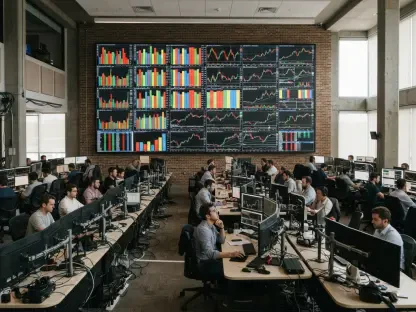

The role of Taiwan Semiconductor Manufacturing Company as the world’s leading foundry makes the Taiex index exceptionally sensitive to global shifts in AI infrastructure spending. This sensitivity became a focal point for global investors recently as the unchecked enthusiasm for artificial intelligence began to encounter a period of sober reassessment. As capital flowed out of high-flying technology names on Wall Street, the resulting pressure created a massive selloff that rippled across international borders with startling speed. Even the high-profile market debut of Anthropic, which initially saw its shares climb significantly above the offering price, failed to serve as the stabilizing force many had hoped for. Instead, the market remained fixated on the looming question of long-term profitability and the sustainability of massive capital expenditures. This growing skepticism quickly transformed a localized retreat into a broader contagion, setting the stage for a tumultuous period in Asian tech hubs where the physical components of the digital revolution are manufactured.
Regional Market Volatility
Impact on Asian Equities
The contagion from New York reached Asian trading floors with such intensity that many local investors referred to the session as a “Dark Friday.” In South Korea, the KOSPI index suffered a dramatic plunge of over 5%, a move so volatile that the Korea Exchange was forced to implement its emergency “sidecar” protocol, which temporarily halts program selling to prevent a full-scale market panic. This was not an isolated incident; Japan’s Nikkei 225 and the Taiwanese Taiex also witnessed substantial retreats, with both losing more than 4% of their value in a single afternoon. Such rapid declines effectively pushed the MSCI Asia-Pacific index toward its most challenging weekly performance since the global disruptions experienced at the start of the 2020 pandemic. These events underscored the extreme vulnerability of regional economies to shifts in technology sentiment, as global funds sought safety away from the semiconductor and hardware sectors that define the Pacific Rim’s growth.
Concentration Risk in Chips
The severity of the downturn in markets like South Korea and Taiwan is primarily a byproduct of the extreme concentration of semiconductor manufacturers within their national benchmarks. These indices are essentially anchored by massive corporate titans such as Samsung Electronics and SK Hynix, which are the primary providers of the high-bandwidth memory chips required for advanced AI infrastructure. Consequently, when international sentiment regarding AI spending begins to sour, these national indices behave more like specialized technology funds than diversified broad-market indicators. This structural reality amplifies any volatility originating in the United States, often causing localized market corrections that are twice as intense as the moves seen on the S&P 500. Investors who hold international funds are often surprised by this magnification effect, as the very hardware that powers the global digital economy also creates a singular point of failure for the equity markets that host these manufacturers.
Retirement Portfolio Resilience
Target-Date Fund Structure
For the vast majority of American retirement savers, the primary exposure to these international market fluctuations occurs through the target-date funds found within their 401(k) plans. These investment vehicles are built with a sophisticated layer of structural protection through aggressive diversification, spreading risk across thousands of individual securities and dozens of distinct countries. For instance, a typical fund designed for an individual planning to retire around 2030 will hold a blend of domestic and international equities balanced by fixed-income assets. This “dilution effect” is a critical safeguard; while a headline might scream about a 5% crash in an Asian market, that specific geography usually represents only a tiny sliver of the total portfolio. By the time a regional shock filters through the various layers of the fund, the impact on the individual saver’s balance is significantly muted, ensuring that a bad day in Seoul does not necessarily equate to a bad year for a retirement nest egg.
Quantifying the Dollar Loss
To put the recent volatility into a more tangible perspective, one can analyze the actual dollar impact on a retirement account with a $500,000 balance. An investor utilizing a standard, well-diversified target-date fund would find that their exposure to the Japanese, Taiwanese, and South Korean markets combined would result in a total loss of approximately $1,772 during a 5% regional crash. In the context of a half-million-dollar portfolio, this drawdown represents only about one-third of 1% of the total account value. This highlights the massive gap between the sensationalized headlines of a global tech meltdown and the actual experience of a long-term investor. While the percentage drops in the Pacific indices were undeniably large, the structural design of modern retirement vehicles effectively buffers the individual from significant wealth destruction. Understanding this math is vital for maintaining an objective perspective when the financial news cycle focuses on short-term market turbulence and regional fluctuations.
Domestic vs. International Influence
The Dominance of U.S. Stocks
A critical reality for anyone tracking their retirement progress is that domestic market movements in the United States exert a far more powerful influence on their balance than any international event. In that same $500,000 portfolio, a relatively standard 2% decline in the S&P 500 would result in a loss exceeding $3,500, which is more than double the dollar impact of a much more severe 5% crash across Asian markets. This discrepancy exists because most American retirement funds are heavily weighted toward domestic equities, which remain the primary engine of long-term wealth accumulation for U.S.-based savers. Consequently, many investors do not even “feel” the booms or busts occurring in foreign markets, as the overwhelming majority of their portfolio value is tied to the performance of companies listed in New York. While global events are important for thematic understanding, the domestic trajectory of the economy remains the most significant variable for the average person’s financial security and future goals.
Historical Context of Growth
Understanding the current market correction requires looking back at the preceding growth cycle that took place earlier in 2026. During the first half of the year, the South Korean KOSPI index experienced an extraordinary surge, more than doubling in value within a span of just six months before reaching its eventual peak. For a participant in a target-date fund, this extreme volatility was smoothed out through a disciplined rebalancing strategy. When the market was doubling, the retirement fund saw only a marginal increase in its total value; conversely, as the market entered its current correction phase, the downside impact was equally restrained. This illustrates the stabilizing power of a diversified investment strategy, which prevents investors from being overly exposed to the manic highs and depressing lows of any single regional economy. By focusing on long-term trends rather than short-term spikes, savers were able to maintain a steady course toward their retirement objectives without being derailed by localized cycles.
Technical Nuances of Investing
Index Classification Differences
Exposure to volatile international markets can vary significantly depending on the specific index that a chosen fund tracks, such as those provided by MSCI or FTSE Russell. These index providers often maintain different philosophies regarding how to categorize specific nations; for example, MSCI continues to label South Korea as an “Emerging Market,” while FTSE Russell considers it a “Developed Market.” This distinction is not merely academic, as it dictates how much exposure an investor actually has to a regional selloff. An emerging markets fund linked to MSCI might have nearly 17.5% of its assets in South Korean companies, whereas a fund following the FTSE index would have zero exposure to that same country, potentially shifting that weight toward Taiwan instead. For those who choose to supplement their retirement plans with specialized international ETFs, understanding these underlying classifications is essential for identifying where their risks are concentrated and how a specific global event will impact their bottom line.
The Interconnected Tech Trade
The most significant takeaway for investors was the realization that the “AI trade” has become a globally interconnected phenomenon that defies simple geographic boundaries. While news reports focused on specific exchanges in Taipei or Tokyo, the underlying reality remained that the technology giants in the United States were fundamentally linked to the manufacturing capacity of Asia. A shift in global sentiment regarding artificial intelligence reached retirement accounts from multiple directions simultaneously because the same economic themes drove both domestic and foreign holdings. To navigate this environment, many savers reviewed their asset allocations and confirmed that their diversification strategies functioned as intended during the recent volatility. The structural design of these retirement vehicles provided a robust safeguard against localized shocks in an increasingly tech-dependent world. Ultimately, investors who focused on maintaining broad exposure rather than chasing regional trends were best positioned to weather the fluctuations and maintain their long-term financial trajectory.