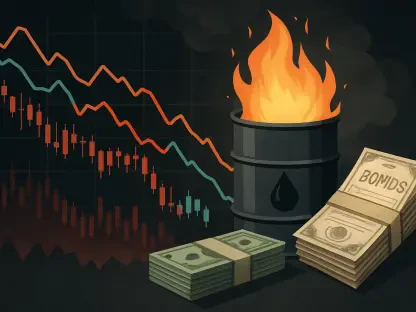

Recent market behavior shows that gold is decoupling from its usual drivers, falling even when economic signals like jobless claims suggest a softening economy. This structural shift marks a departure from traditional trading patterns where bullion served as a primary refuge during periods of labor market weakness. In the current environment, the December gold futures contract has faced a relentless onslaught of selling pressure, dropping from an opening of $3,730.30 to an intraday low of $3,620.60 within a high-velocity trading window. The speed of this correction, which wiped out over $100 in a single day, highlights a market that is increasingly insensitive to typical bullish catalysts. Instead of reacting to soft economic data with the expected rally, gold prices have continued to crater, signaling that global capital is prioritizing yield and liquidity over the safety of physical assets. This divergence suggests that the fundamental valuation model for gold is undergoing a significant and painful transformation in the face of persistent fiscal pressures and a shifting monetary landscape.
Technical Breakdown and Selling Pressure
Rapid Price Erosion
The collapse of the $3,700 psychological level has fundamentally altered the technical landscape for gold, turning what was once a sturdy floor into a formidable ceiling of resistance. During recent sessions, the market demonstrated a complete lack of dip-buying interest, as sellers overwhelmed the order book at every attempt to find a short-term bottom. By settling near the absolute lows of the daily range, the December contract confirmed that late-day buyers are currently nonexistent, leaving the market vulnerable to further downside. This aggressive selling is not merely a reflection of individual investor sentiment but is being fueled by automated stop-loss triggers and forced liquidations in the futures market. As prices slice through long-standing support levels with almost no friction, the velocity of the decline has taken on a life of its own. This technical breakdown indicates that the market is in a “falling knife” scenario where participants are more concerned with exiting positions than with identifying potential value at these depressed levels.
Broad Market Correction
Over the span of just eight trading sessions, the gold market has endured a staggering loss of approximately $520, representing a double-digit percentage decline that has shocked institutional observers. This rapid descent has pushed prices nearly 37% below the record high of $5,780 established earlier this year, marking one of the most severe corrections in recent memory. The market has effortlessly bypassed previous support milestones, including the summer lows above $4,000 and the October support near $3,900, suggesting a total breakdown in bullish conviction. This broad correction reflects an exhaustion of the long-term trend that had dominated the first half of the year. With the asset now trading in a territory that few analysts expected to see so quickly, the focus has shifted toward finding a structural bottom. The absence of a stabilizing consolidation phase suggests that the market may need to undergo further deleveraging before any semblance of a recovery can take hold, as institutional portfolios continue to rebalance away from the sector.
The Dominance of Treasury Yields
The Five Percent Benchmark
The primary force driving this historic selloff is the dramatic surge in U.S. Treasury yields, which have redefined the opportunity cost of holding non-yielding bullion. The 10-year Treasury yield recently spiked from 4.82% to a peak of 5.17% following a hotter-than-expected Consumer Price Index report. This move above the 5% threshold has fundamentally changed the calculus for institutional investors who previously held gold as a diversification tool. When government-backed debt offers a “risk-free” return of over 5%, the argument for maintaining large positions in gold, which carries storage costs and offers no dividend, becomes difficult to sustain. This paradigm shift has led to a massive reallocation of capital into the bond market, putting immense downward pressure on precious metals. The correlation between the 10-year yield and gold prices has tightened significantly, with even small basis point increases in yields triggering disproportionately large selloffs in the futures market as the global search for yield intensifies.
Internal Selling Momentum
A troubling development in the current market cycle is that gold has begun to decline even on days when Treasury yields show signs of retreat. For example, when weekly jobless claims rose to 203,000—a signal that would typically cool interest rate expectations—the 10-year yield dipped to 5.05%, yet gold still lost over $100 in value. This suggests that while rising rates were the initial spark, the selloff has now gained its own internal momentum that transcends daily economic data. The market is currently caught in a self-perpetuating feedback loop where technical failures lead to more selling, regardless of the underlying macroeconomic backdrop. This decoupling from fundamental logic indicates a phase of market capitulation, where the fear of further losses outweighs any long-term valuation metrics. Until the market can break this cycle of momentum-driven liquidation, even favorable economic reports are unlikely to provide more than a temporary reprieve for bullion prices, as the path of least resistance remains firmly to the downside for the time being.
Investor Sentiment and Future Outlook
Institutional vs. Central Bank Flows
The current market landscape is defined by a sharp divide between “hot money” institutional flows and the “patient money” of global central banks. Institutional investors have been exiting the space at a record pace, with major exchange-traded funds like the SPDR Gold Trust and the iShares Gold Trust seeing combined outflows exceeding $1.6 billion in just the last month alone. These Western-based investors are highly sensitive to real interest rates and are rapidly rotating their capital into higher-yielding fixed-income instruments. In contrast, the World Gold Council reports that central banks increased their gold purchases by 42% year-over-year in the third quarter, accumulating 321 tons of the metal. While this sovereign demand provides a long-term fundamental floor, it lacks the immediate liquidity needed to absorb the massive volumes of selling coming from the futures and ETF markets. Furthermore, divergence among central banks, such as Turkey offloading 60 tons this year, has added another layer of complexity for the sector.
Critical Support and Fed Policy
As the market looks for a potential bottom, the $3,500 level has emerged as the most critical technical milestone that gold must defend to avoid a structural collapse. This price point represents a historical junction that has served as a triple-top resistance in the past, and its role as support will determine the metal’s valuation trajectory through the end of the year. Much of this outcome will depend on the upcoming Federal Reserve meeting scheduled for December 8-9, where officials are widely expected to implement a quarter-point rate hike. However, the market’s primary focus will not be the hike itself but rather the Fed’s “dot plot” and its long-term economic projections for 2027. If the central bank signals that high interest rates will remain a permanent fixture of the landscape, the pressure on gold will likely intensify. Conversely, any hint of a policy pivot could provide the spark needed for a recovery. Until then, the $3,500 floor remains the last line of defense for a market that is struggling to find its footing.
The Shift Toward Yield Discipline
The transition into this higher-yield environment forced a total reassessment of how precious metals fit into a modern institutional portfolio. Market participants observed that the traditional inverse relationship between gold and economic distress weakened significantly as the allure of high-interest bonds became the dominant market theme. The previous strategies that relied on gold as a primary hedge against labor market softening were effectively neutralized by the sheer gravity of the 10-year Treasury yield. As the market moved toward the end of the year, the focus shifted toward identifying where the reset of the valuation model would finally stabilize. Investors began to look beyond short-term volatility, recognizing that a return to the record highs of earlier sessions would require a fundamental breakdown in the current interest rate paradigm. Future strategies must now account for a world where gold is no longer the default safe haven but a component in a more complex ecosystem. Discipline and a close eye on the $3,500 support level were essential for navigating this new reality.