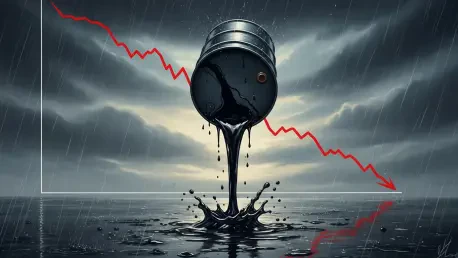

Global energy markets are currently witnessing a rare phenomenon where the sound of military engines is being drowned out by the quiet whispers of high-stakes diplomatic maneuvering. Despite the implementation of a rigorous naval blockade in the Middle East, West Texas Intermediate and Brent crude futures unexpectedly tumbled by 2% to the $97 per barrel mark. This divergence reveals a complex environment where political signaling currently holds more weight than the traditional fears of immediate supply scarcity.
Decoding the Divergence Between Military Action and Market Sentiment
The current decline in oil prices suggests that traders are prioritizing a “wait and see” approach rather than reacting with reflexive panic. This shift is significant because it highlights a sophisticated marketplace that now values geopolitical rhetoric as much as physical inventory levels. Investors are essentially betting that the current tension is a calculated performance rather than a precursor to a total energy shutdown.
Furthermore, the push-and-pull dynamics between the newly established U.S. naval blockade and the optimistic communications from the White House have created a unique price floor. While the presence of warships usually sends prices skyrocketing, the simultaneous promise of an exit ramp has kept the $97 threshold stable for the time being.
Navigating the Geopolitical Tightrope: Supply Shocks versus Diplomatic De-escalation
The Rhetoric of Restraint: How Diplomatic Signaling Cools Global Futures
Vice President JD Vance’s recent remarks regarding a potential peaceful resolution have served as a powerful stabilizing force for energy markets. By framing the situation as a moment where the “ball is in the Iranian court,” the administration has provided a psychological buffer for global traders. This narrative suggests that as long as a path to negotiation remains open, the threat of a full-scale conflict remains manageable.
However, the challenge lies in reconciling these hopeful timelines with the rigid requirements of the Iranian nuclear program and the strict conditions set by U.S. negotiators. If these diplomatic windows begin to close, the cooling effect on global futures could evaporate overnight, leaving the market vulnerable to a sharp correction.
Tactical Shifts on the Water: Clarifying the Scope of the U.S. Naval Blockade
The nature of the current blockade has been refined to target specific Iranian coastal zones rather than the broader Strait of Hormuz. This tactical shift is designed to restrict Iranian port access while attempting to minimize collateral damage to the general flow of global shipping. By narrowing the scope, the administration aims to isolate the target without triggering a global economic catastrophe.
Energy firms operating in the Persian Gulf are currently forced to navigate these invisible physical boundaries with extreme caution. While the restricted zones are specific, the risk of an accidental escalation remains high, keeping insurance premiums volatile even as the price per barrel experiences a temporary dip.
Market Psychology vs. Physical Reality: The 1.7 Million Barrel Question
There is a stark contrast between the warnings issued by institutions like the Commonwealth Bank of Australia and the current bearish behavior of market participants. While some experts caution that the world could lose 1.7 million barrels of daily exports, investors seem focused on the potential for a breakthrough. This suggests a belief that the blockade is a temporary leverage tool rather than a permanent fixture.
This trend challenges the long-held assumption that supply constraints must always lead to immediate price hikes. In a landscape dominated by rapid-fire digital updates, the perception of a diplomatic solution can effectively neutralize the reality of physical shortages for a sustained period.
Global Energy Equilibrium: Comparative Perspectives on Modern Oil Shocks
The reaction of modern markets differs significantly from historical oil crises due to the speed of information flow. Today, Asian and European markets are pricing in risk with a level of nuance that was not possible in previous decades. This allows for a more distributed impact, where regional differences in energy reserves help mitigate the initial shock of an export halt.
Should the current negotiations collapse, the global energy equilibrium would likely undergo a violent recalibration. In such a scenario, the activation of emergency reserves would become the primary tool for stabilizing prices, but the long-term cost of a sustained blockade would still reverberate through every sector of the global economy.
Strategic Frameworks for Interpreting Volatile Energy Signals
Stakeholders must learn to distinguish between temporary political posturing and genuine, long-term supply chain disruptions. In an era where social and political rhetoric drives action as much as physical production, maintaining a diversified energy portfolio is no longer optional. It is the only way to insulate against the “soft” signals that now dictate market volatility.
Analysts are increasingly weighing military intelligence against diplomatic cues to find near-term price floors. By watching for specific triggers in official statements, observers can better predict whether a price move is a short-term fluctuation or the start of a fundamental shift in the global energy landscape.
The Future of Energy Security in an Era of High-Stakes Diplomacy
The core lesson from this period was that market confidence hinged more on the credibility of a diplomatic exit ramp than on the physical flow of oil. This realization necessitates a shift in how energy security is calculated, moving away from simple barrel counts and toward a deeper analysis of geopolitical relationships. Monitoring the U.S.-Iran dynamic remained the primary barometer for economic stability throughout the crisis.
The fragility of the $97 price point served as a reminder that the strategic necessity of preparing for rapid shifts was paramount. Moving forward, entities that developed agile response plans were better positioned to handle the volatility. The situation highlighted that in the absence of a permanent treaty, the threat of a sudden supply crunch would continue to loom over every diplomatic effort.