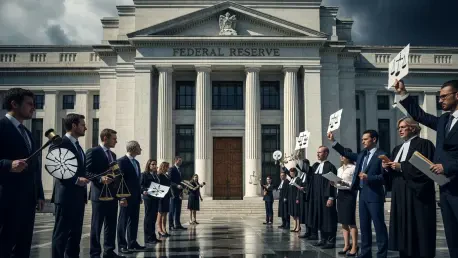

The quiet, marbled corridors of the Federal Reserve’s Washington headquarters have recently transformed into a battlefield where the abstract theories of monetary policy are clashing with the gritty reality of a federal criminal investigation. What started as a routine infrastructure update has spiraled into an unprecedented institutional crisis, pitting the executive branch’s prosecutorial might against the long-guarded sanctuary of central bank independence. As investigators from the U.S. Attorney’s office attempt to breach the Fed’s construction sites, the nation watches a high-stakes drama that could redefine the boundaries of American governance for a generation.
The $2.5 Billion Renovation That Froze Washington
The Federal Reserve is an institution built on the foundation of meticulous scrutiny, yet it now finds its own internal ledgers under the microscope of a federal criminal probe. A massive renovation project for the central bank’s headquarters, originally envisioned as a necessary modernization, has seen its price tag balloon from an early $1.9 billion estimate to a staggering $2.5 billion today. This fiscal expansion has provided the opening for an aggressive legal offensive, as prosecutors investigate whether the skyrocketing costs are a result of systemic mismanagement or something more nefarious.
This conflict reached a fever pitch when investigators attempted an unannounced “tour” of the construction site to verify the progress of the work. This maneuver, aimed at validating Chairman Jerome Powell’s previous testimony regarding the project’s expenses, was met with stiff institutional resistance. By directing federal agents to legal counsel rather than the construction floor, the Fed signaled that it would not be intimidated by what many insiders describe as a politically motivated fishing expedition. The standoff has effectively halted the typical rhythm of Washington, turning a renovation project into a symbol of a much larger struggle for power.
Why This Institutional Friction Matters
Central bank independence is not merely a bureaucratic preference; it is a foundational pillar of global economic stability designed to prevent short-term political whims from dictating long-term financial health. When a presidential administration leverages the machinery of the Department of Justice to challenge the leadership of the Fed, it threatens the very insulation that allows the bank to make unpopular but necessary decisions. This friction creates a ripple effect of uncertainty through global markets, as investors begin to wonder if the hand on the interest-rate lever is being guided by economic data or by the shadow of a pending indictment.
Moreover, the conflict represents a fundamental test of the executive branch’s authority to override the statutory protections afforded to financial regulators. The current administration’s use of a criminal probe to bypass the “for cause” removal requirement for Fed governors suggests a new era of executive assertiveness. If a President can successfully use an investigation into construction costs to force a change in monetary leadership, the traditional independence of the Federal Reserve may become a relic of the past, fundamentally altering the checks and balances inherent in the U.S. financial system.
Anatomy of a Legal and Political Stalemate
The current deadlock is fueled by a volatile mixture of budget overruns and the tactical use of the legal system to achieve political ends. U.S. Attorney Jeanine Pirro’s office has focused its sights on Chairman Powell’s 2023 testimony, searching for discrepancies that could serve as a catalyst for his removal. This aggressive posture has created a chilling effect within the central bank, as officials find themselves navigating a minefield of legal risks while attempting to manage the nation’s economy. The focus on the veracity of project estimates serves as a proxy for a broader dissatisfaction with the Fed’s policy direction.
In the hallowed halls of the Senate, this legal tension has translated into a complete legislative paralysis. The Senate Banking Committee remains deeply divided, with key members like Senator Thom Tillis blocking the confirmation of the administration’s hand-picked successor to the chairmanship. This internal Republican dissent has created a scenario where the President’s own party is acting as the primary obstacle to his vision for the Fed. Without a clear path to confirmation for a new leader, the central bank remains in a state of administrative limbo, unable to transition to new leadership while the current chair refuses to step down under the cloud of a probe.
Expert Perspectives on Institutional Independence
Legal scholars and judicial figures have begun to voice serious concerns regarding the legitimacy of the administration’s tactics. U.S. District Judge James Boasberg has already signaled skepticism, characterizing the sudden interest in the Fed’s renovation as potentially “pretextual.” This judicial wariness suggests that the courts may view the criminal investigation as a thinly veiled attempt to manufacture the “cause” necessary to fire a Fed official. Legal counsel for the Federal Reserve Board has reinforced this view, noting that even within the U.S. Attorney’s office, there has been an admission that no concrete evidence of criminal activity has surfaced despite the intense scrutiny.
On the legislative front, the pushback has been equally forceful. Senator Thom Tillis has argued that the probe is an ill-informed tactical blunder that has backfired on the administration. By making the renovation project a criminal matter, the White House has inadvertently given Jerome Powell a moral and professional reason to remain in his post until 2028 to defend his reputation. This legislative perspective highlights the unintended consequences of using the legal system for political leverage; rather than clearing the way for a new appointee, the investigation has hardened the resolve of the current leadership to stay and fight.
Navigating the Path to Resolution
Breaking this stalemate will likely require a definitive ruling from the highest court in the land. An upcoming Supreme Court decision regarding the removal of Governor Lisa Cook is poised to be the watershed moment for this conflict. The ruling is expected to clarify whether a President can use allegations of past personal conduct—or in this case, administrative oversight—as a legal basis for removing an official who is otherwise protected by law. This judicial clarity will provide the necessary framework to determine if the executive branch has overstepped its constitutional bounds or if the Fed’s independence has limits that have yet to be tested.
In the final analysis, the path forward required a delicate realignment of administrative tactics and legislative reality. The pursuit of a criminal probe into construction costs proved to be a double-edged sword that hindered the confirmation process more than it facilitated leadership change. Moving toward a resolution demanded a shift from prosecutorial aggression to strategic compromise within the Senate Banking Committee. Ultimately, the survival of the Federal Reserve’s traditional autonomy depended on whether the legal system upheld the “for cause” standard or allowed the executive branch to redefine the criteria for removal through the lens of institutional performance and cost management.