
The unprecedented escalation of military friction involving the United States, Israel, and Iran has fundamentally fractured the foundations of international stability, precipitating a systemic collapse of global energy markets that dwarfs any historical precedent. Unlike previous shocks that were characterized by temporary supply dips or manageable price hikes, the current environment is defined by a total rupture of traditional supply chains and a transition of energy resources from commodities into primary instruments of geopolitical warfare. As nations grapple with the immediate fallout, the crisis has transcended the energy sector to threaten the very continuity of the global economy, forcing an urgent and painful reassessment of how industrial civilizations power their future. This is no longer a localized conflict with secondary economic ripples; it is a transformative event that has effectively dismantled the old order of energy interdependency, leaving every major economy to fight for its survival in a market where scarcity is the new baseline and the cost of failure is total industrial paralysis.
Geopolitical Instability in the Strait of Hormuz
The primary engine of this modern catastrophe remains the volatile landscape surrounding the Strait of Hormuz, a maritime corridor where the passage of one-fifth of the global oil supply is now routinely jeopardized by direct military engagement. Recent months have seen a series of targeted attacks on critical infrastructure and commercial shipping vessels, effectively turning this narrow waterway into a high-stakes arena of diplomatic and military pressure. For global energy corporations and government strategic planners, the security of these transit routes is no longer a reliable assumption but a constant variable in an equation of extreme risk. This instability has forced a massive logistical redirection, yet the physical constraints of global geography mean that there are few viable alternatives capable of handling the sheer volume of fuel required to sustain international commerce. Consequently, the Strait has become a powerful geopolitical lever, where the mere threat of a closure can send shockwaves through financial markets, demonstrating that the world’s energy heart remains precariously exposed to regional hostility.
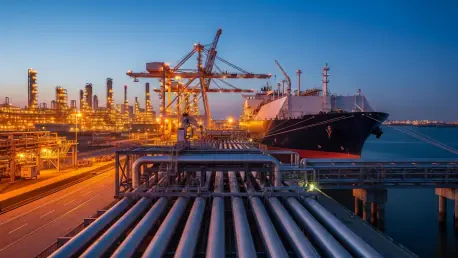
The weaponization of energy resources has fundamentally altered the nature of international relations, moving the focus from economic negotiation to a doctrine of defensive energy posturing. Governments that previously relied on the free flow of Middle Eastern crude are now confronting a reality where energy is utilized as a tool of coercion, prompting a desperate search for security outside traditional frameworks. This shift is characterized by a breakdown in trust between producers and consumers, as the reliability of long-term contracts is sacrificed at the altar of immediate geopolitical gain. The direct attacks on refineries and loading terminals have not only diminished physical supply but have also introduced an “instability premium” that stays embedded in fuel prices regardless of actual production levels. As these costs permeate every level of the global supply chain, the world is witnessing the emergence of a new economic era where the ability to protect energy transit is just as critical as the ability to extract the resources themselves, leaving many nations vulnerable to forces entirely beyond their control.
Divergent Regional Economic Impacts and Resilience
The impact of the current energy shock has been distributed unevenly across the globe, revealing deep-seated structural vulnerabilities that differ sharply from one region to the next. Europe currently faces the most severe economic headwinds, as the continent’s previous reliance on external suppliers has left its industrial core exposed to unsustainable electricity price surges. In manufacturing powerhouses like Germany and France, the cost of powering heavy industry has frequently exceeded the value of the goods produced, leading to widespread factory closures and a looming threat of permanent deindustrialization. This disparity is particularly evident when comparing European operating costs to those in regions with more robust domestic resources, creating a competitive gap that threatens to sideline European exports in the global market. The social consequences are equally profound, as governments struggle to subsidize household heating and power while maintaining fiscal discipline, leading to a period of intense political friction and a questioning of the established economic models.
In sharp contrast, the United States has leveraged its domestic shale oil and gas revolution to provide a critical, if imperfect, cushion against the most severe supply shortages. As a net energy exporter, the American economy possesses a level of insulation that was unimaginable during the crises of the previous century, yet the nation remains far from immune to the global pricing surge. High commodity prices have translated into significant domestic inflation, with gas prices consistently exceeding $6.00 per gallon at the pump, which in turn reshapes consumer behavior and creates a volatile political atmosphere ahead of major election cycles. While the U.S. industrial sector benefits from lower input costs compared to its European counterparts, the interconnectedness of global finance means that high energy costs elsewhere still weigh on American trade and investment. This scenario highlights a complex paradox: even a nation with energy independence cannot fully escape the gravitational pull of a global crisis, as the cost of living continues to climb despite the abundance of domestic production.
Strategic Shifts in Asian Dependency and Russian Influence
Asia’s profound reliance on Middle Eastern energy sources has created a uniquely precarious situation for the world’s most populous region, where roughly 60 percent of oil requirements are met through imports from the Gulf. Nations like Japan and India have found themselves in a desperate scramble to secure alternative supplies as disruptions in the Strait of Hormuz threaten to stall their economic growth. While these countries face significant logistical hurdles and rising costs, China has managed to mitigate some of the damage through the aggressive implementation of long-term strategic reserves and a highly diversified energy portfolio. Beijing’s ability to draw from vast stockpiles and pivot toward land-based pipelines from Central Asia has provided a degree of stability that its neighbors lack. This regional divergence is creating a new hierarchy in Asia, where the capacity to manage energy risk is becoming the primary determinant of economic leadership and geopolitical influence, forcing every nation to rethink its long-term strategic dependencies.
Meanwhile, the current crisis has provided Russia with a strategic opening to expand its influence by filling the supply gaps created by Middle Eastern instability. Despite ongoing international sanctions and political pressures, Moscow has successfully leveraged its massive energy infrastructure to supply hungry markets, often operating through complex shipping networks and alternative payment systems. This opportunistic pivot has allowed Russia to maintain its economic relevance even as global trade rules are being rewritten in real-time. By positioning itself as a “supplier of last resort” for nations desperate to avoid total economic paralysis, Russia has effectively exploited the vacuum left by the collapse of traditional Gulf supply routes. This shift illustrates how the energy crisis is redrawing the map of global trade, as countries are increasingly willing to overlook political considerations in favor of securing the fuel necessary to keep their lights on and their industries functioning, ultimately weakening the effectiveness of traditional diplomatic tools.
Redefining National Security Through Energy Autonomy
Energy security has rapidly evolved from a concern of economic policy into an existential requirement for national survival, fundamentally changing how governments prioritize their internal investments. For low-income nations, the current environment has created a humanitarian trap where the inability to afford high prices prevents the acquisition of basic fuel supplies, leading to widespread power outages and social unrest. At the same time, high-income countries are beginning to realize that their technological and industrial superiority is meaningless if the power grids supporting AI infrastructure and advanced manufacturing are unstable. This realization has shifted the narrative surrounding the energy transition; moving away from fossil fuels is no longer just an environmental goal but a critical national security imperative. The focus has moved toward technologies that can be deployed locally, such as wind, solar, and green hydrogen, because these sources eliminate the “geopolitical tax” associated with importing energy from volatile regions across the world.
This new era of energy policy has also sparked a massive and widespread resurgence in nuclear power as nations seek a reliable, carbon-neutral base-load supply. Small modular reactors and traditional large-scale plants are being fast-tracked in various jurisdictions to provide a steady foundation for grids that are increasingly strained by the volatility of international fuel markets. By investing heavily in a diversified mix of domestic power sources, governments aim to insulate their economies from the whims of foreign regimes and the hazards of maritime transit. This shift toward localized production is not merely about sustainability; it is about building a resilient infrastructure that can withstand the collapse of global trade corridors. As the 2026 crisis continues to unfold, the consensus among global leaders has hardened around the idea that true sovereignty is impossible without energy autonomy, leading to a massive reallocation of capital toward technologies that promise a future free from the cycles of international resource conflict.
Rebuilding Stability and Future Energy Frameworks
The sheer scale of the disruption witnessed throughout the current year is reflected in staggering figures that highlight the fragility of the modern world. With over 12 million barrels of oil per day lost to conflict and the closure of key transit routes, the global economy has faced a deficit that no single producer or technology could immediately bridge. The simultaneous loss of 20 percent of global liquefied natural gas production, primarily originating from Qatar, has crippled electricity generation and heating in multiple hemispheres, while a shortage of refined fuels has paralyzed global logistics and aviation. This multi-layered crisis has proven that the current international framework for energy security was wholly inadequate for a world where energy is treated as a primary weapon. Even if military tensions were to subside immediately, the physical damage to infrastructure and the total erosion of trust between trading partners would ensure that the road to recovery remains long and fraught with significant economic challenges for every participating nation.
Restoring global stability required more than just a temporary cessation of hostilities; it demanded a fundamental overhaul of the international energy architecture to prevent such a collapse from ever occurring again. The global community moved toward establishing new frameworks that prioritized the protection of maritime corridors through international guarantees, while simultaneously accelerating the move toward a decentralized energy model. This new approach favored local production and deep diversification, ensuring that the loss of a single geographic chokepoint could no longer bring the world to a standstill. Policymakers ultimately recognized that the expansion of nuclear and renewable sources was the only viable path to long-term resilience. The high price paid in inflation and industrial decline served as a definitive catalyst for a permanent shift in how energy is sourced and protected. By the end of this period, the world had begun to transition into a more fragmented but ultimately more durable energy landscape, where the lessons of the crisis were hard-coded into every national security strategy moving forward.