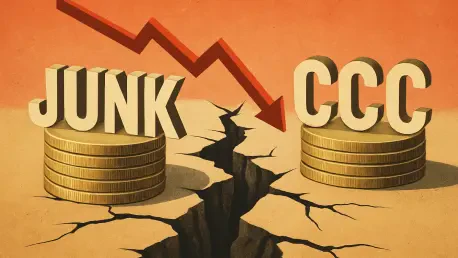

Investors are increasingly questioning whether artificial intelligence can sustain economic growth, leading to heightened skepticism toward speculative-grade corporate debt. This shift in sentiment represents a significant pivot from the early enthusiasm that defined much of the current year. As the speculative bubble surrounding generative technologies begins to deflate, creditors are closely examining the underlying fundamentals of highly leveraged companies. The previous assumption that technological productivity would automatically offset rising operational costs is now being tested by reality. Consequently, the high-yield market is witnessing a sharp divergence in performance, creating a landscape where credit quality is the primary determinant of survival. Investors are no longer willing to overlook the structural weaknesses of bottom-tier borrowers, even in an environment where broader equity markets remain relatively resilient. This emerging caution reflects a deeper fear that the promised economic miracle may arrive later than expected, leaving heavily indebted firms exposed to high interest rates without the anticipated revenue boost from tech integration.
Dynamics of Market Bifurcation
Threshold of Distress: CCC Rating Breakdown
The riskiest segment of the corporate bond market, specifically those obligations rated CCC, has crossed a critical threshold that signifies deep systemic anxiety. Recent data indicates that yields for these low-tier bonds have surged to approximately 16.15%, pushing credit spreads to a staggering 1,135 basis points. In professional trading circles, any spread exceeding 1,000 basis points is formally classified as distress territory, a level of volatility and risk premium that has not been observed since the global economic disruptions of the summer of 2020. This spike is not merely a statistical anomaly but a signal that capital is actively fleeing the most vulnerable companies. Such firms are finding it nearly impossible to attract buyers without offering astronomical returns that further strain their already fragile balance sheets. This development has effectively isolated CCC-rated issuers from the broader investment community, as the cost of borrowing now far exceeds the projected growth rates for most of these struggling businesses, creating a self-reinforcing cycle of financial deterioration.
Stable Foundations: Resilience in Higher Tiers
While the bottom tier of the market is in turmoil, a clear bifurcation has emerged as higher-quality junk bonds, such as those with BB or single-B ratings, maintain a surprising level of stability. The broader high-yield index continues to trade with a more modest spread of roughly 3.52%, illustrating a profound disconnect between different grades of speculative debt. This divergence suggests that professional portfolio managers are being extremely selective rather than initiating a wholesale exit from the high-yield sector. Companies with stronger cash flows and manageable debt schedules are still viewed as viable investments, allowing them to remain insulated from the chaos affecting their lower-rated counterparts. This selective behavior highlights a flight to quality within the sub-investment-grade space itself, where the primary concern is the idiosyncratic risk of individual corporate failures. As long as these mid-tier companies can prove their operational resilience, they are likely to avoid the extreme pricing pressures currently suffocating the most distressed issuers in the market.
Primary Market Stagnation and Future Outlook
Financing Bottleneck: The October Collapse
The practical implications of this market split are most visible in the sudden stagnation of primary issuance, which has seen a dramatic contraction over the past several weeks. U.S. junk bond issuance plummeted from a robust $51 billion in September to a meager $7 billion by the end of October, marking one of the most abrupt pauses in lending activity in recent memory. This collapse was driven by a combination of stubborn Treasury yields and a resurgence of inflation concerns that made lenders wary of committing to long-term fixed-rate obligations. Furthermore, over $5 billion in planned debt sales were abruptly postponed or withdrawn entirely as corporate treasurers refused to accept the punishingly high interest rates demanded by increasingly skittish investors. This standoff between issuers and lenders has created a refinancing wall that poses an existential threat to firms with upcoming maturities. Without access to affordable credit, these companies are forced to consider more expensive private credit options or face the prospect of restructuring, as the era of easy money is replaced by fiscal discipline.
Strategic Recalibration: Navigating the New Credit Cycle
To navigate this fractured landscape, market participants must look beyond headline indices and focus on the fundamental health of specific industrial sectors and individual credit profiles. The current stress within the CCC-rated tier is a precursor to a broader economic recalibration, where the focus is shifting from pure growth to debt sustainability and efficient capital allocation. Investors who successfully weather this period do so by diversifying away from the most distressed credits while maintaining positions in companies with proven pricing power and robust liquidity cushions. Future considerations include a rigorous assessment of how sustained higher interest rates will impact the debt-to-equity ratios of firms that are currently just above the distress threshold. While the immediate crisis appears localized among the weakest borrowers, the potential for contagion remains a significant factor if widening spreads begin to migrate toward the B and BB categories. The emphasis has shifted to proactive monitoring of maturity schedules and a heightened sensitivity to macroeconomic shifts that could further tighten credit conditions.