
Economists at Standard Bank Group warn that the current real-term decline in sales reflects sustained financial pressure that wage growth can no longer offset. The South African retail landscape is currently navigating a period of profound uncertainty as the initial momentum recorded in early 2026 begins to dissipate under the weight of severe macroeconomic constraints. While the sector demonstrated resilience during the first half of the year, a toxic combination of mounting inflationary pressures, aggressive interest rate hikes, and geopolitical instability has started to drain the financial reserves of many households. This visible deceleration in growth serves as a critical warning sign for the broader national economy, suggesting that the consumer’s role as the primary engine of market expansion is being systematically undermined. As the cost of living continues to rise, the gap between household income and essential expenses is widening, creating a precarious environment for retailers who must now contend with a population forced to choose between basic necessities.
Measuring Global Shocks and Local Momentum
By late 2026, statistical data indicates a cooling of the retail environment, with real growth figures falling short of market projections. A year-on-year increase of 2.4% in September failed to meet the anticipated 2.9% target, yet the more alarming trend is found within the seasonally adjusted month-on-month data, which showed a second consecutive contraction. These back-to-back declines signal that the retail sector has transitioned into a cyclical downturn, moving away from a post-recovery stabilization phase into a struggle for basic sustainability. The loss of momentum is concerning because it occurs during a period when seasonal spending typically begins to ramp up, suggesting that the underlying financial exhaustion of the consumer is deep-seated. Retailers are facing a reality where volume growth is stagnant, and any revenue increases are merely a reflection of price inflation rather than an actual expansion in consumer demand or market reach across various regions.
Economists identify a critical tipping point where cost-push inflation, driven largely by skyrocketing fuel prices, is finally outpacing the modest wage growth achieved across major sectors. Until recently, relatively stable food prices helped provide a buffer for household budgets, allowing consumers to absorb higher costs in other areas without a total collapse in their standard of living. However, this fragile equilibrium is disintegrating as global energy market disruptions, stemming from escalating tensions between the United States and Iran, push local transportation costs to historic highs. When inflation consistently exceeds income growth, the resulting erosion of real disposable income forces families to abandon discretionary spending entirely. This shift effectively stalls the retail engine, as money that would have been spent on apparel or electronics is instead diverted toward the rising cost of commuting and basic logistics. The psychological impact of these rising costs also plays a significant role in spending behavior.
Market Performance and Strategic Resilience
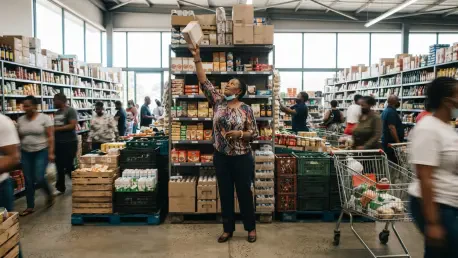
Current economic strain is not felt equally across all retail categories, revealing a stark divide between essential goods and luxury items. General retailers remain the primary pillar of support for the industry, as consumers continue to prioritize daily necessities and groceries above all else. This category demonstrates that while people are spending less, they cannot stop buying food and basic supplies. However, even within this resilient sector, there is clear evidence of consumers opting for store brands to make their money stretch further. This behavior underscores the defensive posture of the modern shopper. Conversely, sectors like clothing and footwear have seen growth rates plunge, serving as a canary in the coal mine for a wider market slowdown. Furthermore, interest-rate-sensitive areas like hardware and furniture are suffering as the high cost of credit forces homeowners to defer major purchases. This divergence suggests a bifurcated landscape where the gap between essentials is widening.
Despite a relatively stable third quarter that contributed positively to the national GDP, the outlook for the final months of the year remains grim due to external shocks and restrictive monetary policy. The South African Reserve Bank’s decision to hike interest rates has significantly increased the burden of debt service for mortgages and loans, leaving households with less capital for retail consumption. While slight improvements in employment may offer a small safety net for essential goods, the combination of permanent high fuel costs and stagnant real wages suggests that the retail sector is facing a period of prolonged stagnation. Economists emphasize that the strength seen in July was likely a temporary peak before the full weight of the October fuel hikes hit the market. Without a meaningful intervention or a shift in global energy dynamics, the retail sector’s contribution to economic growth is expected to remain muted throughout the remainder of the year as the economy adjusts.
Retailers successfully navigated these challenges by prioritizing operational efficiency and diversifying their supply chains to mitigate global volatility. Major industry players shifted toward digital integration, allowing them to optimize inventory management and reduce the overhead costs that previously threatened their margins. Financial institutions implemented strategic debt-restructuring programs that provided a necessary cushion for households, preventing a total collapse in consumer credit availability. These actions fostered a resilient commercial ecosystem that emphasized value-driven offerings over luxury expansion. Forward-looking strategies included localized sourcing and the adoption of energy-efficient logistics to combat the permanent rise in transportation costs. By the end of the period, the sector demonstrated that agility and data-driven decision-making were essential for survival. Stakeholders focused on long-term sustainability rather than short-term gains, ensuring the industry remained a vital component of the economy.