
Priya Jaiswal is a leading voice in global energy economics, bringing years of experience in market analysis and portfolio management to the table. As regional conflicts reshape the flow of the world’s most vital commodities, her insights into how energy giants balance surging profits with geopolitical blockades are more relevant than ever. In this discussion, we explore the strategic maneuvers required to maintain global energy security when traditional maritime routes are suddenly closed by military action.
Profits have surged by 25% to $32.5 billion while oil prices fluctuate between $70 and over $103 per barrel. How do these margins impact long-term infrastructure investment, and can you provide specific metrics on how price volatility changes your operational spending versus your dividend commitments?
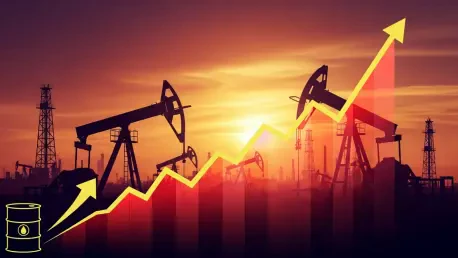
The recent jump in profits to $32.5 billion provides a necessary financial cushion, especially after the industry navigated a 12% decline in annual profits throughout 2025. When prices climbed from a baseline of $70 in late February to peaks above $119 during the height of the conflict, it created a volatile environment that demands a disciplined approach to capital allocation. We are seeing a strategic shift where these heightened margins are being funneled directly into domestic infrastructure to ensure we can bypass traditional chokepoints. While the current price of Brent crude has settled around $103.91, the focus remains on leveraging this cash flow to protect the global economy from further energy shocks rather than just short-term gains. This revenue allows for the maintenance of a global network that can withstand the “headwinds” of war while still meeting the expectations of stakeholders who rely on stable energy production.
The East-West Pipeline is currently running at its maximum capacity of 7 million barrels daily to bypass the Strait of Hormuz. What specific technical hurdles arise when pushing infrastructure to its limit, and what step-by-step measures are taken to maintain the safety and integrity of the total production volume?
Operating the East-West Pipeline at its absolute limit of 7 million barrels per day is a massive undertaking that requires constant technical vigilance across the entire span from the Eastern oil fields to the Red Sea. When you realize that this volume is only a portion of the 11.1 million barrels produced daily in late 2025, the pressure to maintain 100% uptime becomes a matter of international security. Our engineers must monitor pressure gradients and thermal expansion continuously to prevent any structural fatigue that could lead to a catastrophic leak or shutdown. Safety protocols involve real-time sensor arrays and rapid-response teams stationed along the trans-continental route to ensure that the “relief” provided to international customers isn’t interrupted. Pushing the equipment to its mechanical ceiling means we have to sacrifice some of the flexibility usually found in the system, making the integrity of every pump station vital to the global supply chain.
Approximately 20% of the world’s oil and natural gas supplies are currently facing distribution hurdles due to regional instability. How are global supply chains being restructured to compensate, and what anecdotes or regional examples can you share regarding how international customers are reacting to these shifts in energy security?
The sudden disruption of the Strait of Hormuz, where 20% of the world’s traded oil typically flows, has forced a complete reimagining of how energy reaches the market. International customers are understandably anxious, as they are witnessing a “stark reminder” that the era of easy, undisputed transit is currently on hold following the events of late February. We are seeing a heavy reliance on the pipeline route to the Red Sea as a primary alternative, which has allowed us to mitigate the impact of what could have been a total energy standstill. Customers in Europe and Asia are now prioritizing “reliable energy supply” over cost-efficiency, often seeking long-term guarantees that their shipments will bypass the contested waters entirely. The reaction on the ground is one of high alert, with many nations realizing that their industrial stability is tethered to these narrow inland corridors rather than the open seas.
Following the escalation in late February and the subsequent naval blockade, the maritime landscape has become increasingly complex for energy exports. How does a major producer navigate these military constraints on the water, and what specific alternative routes or logistics strategies are being explored beyond existing trans-continental pipelines?
Navigating a landscape where a critical waterway has been effectively seized after attacks on February 28 requires a blend of military coordination and logistical pivoting. When a naval blockade complicates the use of traditional routes, the strategy shifts toward maximizing every inch of domestic infrastructure that leads to safer waters. Beyond the East-West Pipeline, the focus has moved toward diversifying export terminals and leveraging a global network to reroute tankers before they even enter high-risk zones. We have to treat the maritime situation as a dynamic puzzle, where real-time intelligence dictates whether a cargo is sent via a pipeline or staged at a different port to avoid the disruption. This proactive stance is the only way to navigate the “headwinds” created by the conflict and ensure that the vital contribution of oil and gas to the global economy remains uninterrupted.
What is your forecast for the global energy market?
I expect the market to remain in a state of high-tension equilibrium where prices hover in the triple digits as long as the 20% of supply usually moving through the Strait remains contested. While the shift to a 7-million-barrel pipeline capacity has provided a vital safety valve, the global economy will continue to feel the pinch of the “energy shock” until total production levels of over 11 million barrels can be safely transported again. We will likely see an accelerated investment in inland infrastructure and a permanent shift in how energy security is defined, moving away from a reliance on vulnerable maritime chokepoints. The future of the market depends entirely on the ability of major producers to maintain these alternative routes while the geopolitical landscape remains so volatile and unpredictable.